
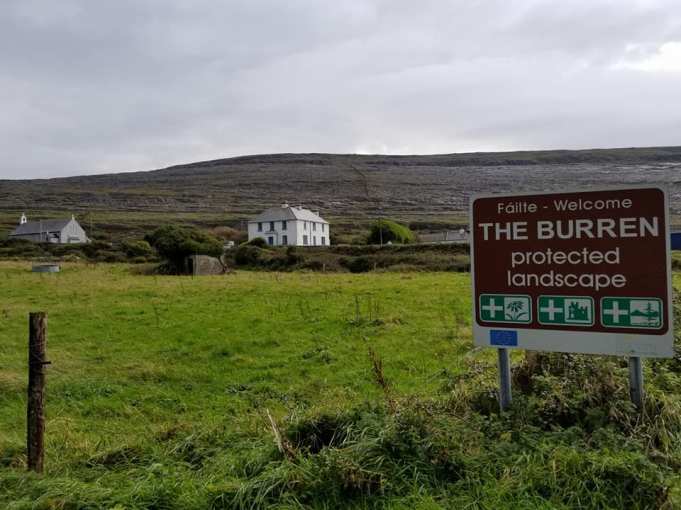
THE BURREN
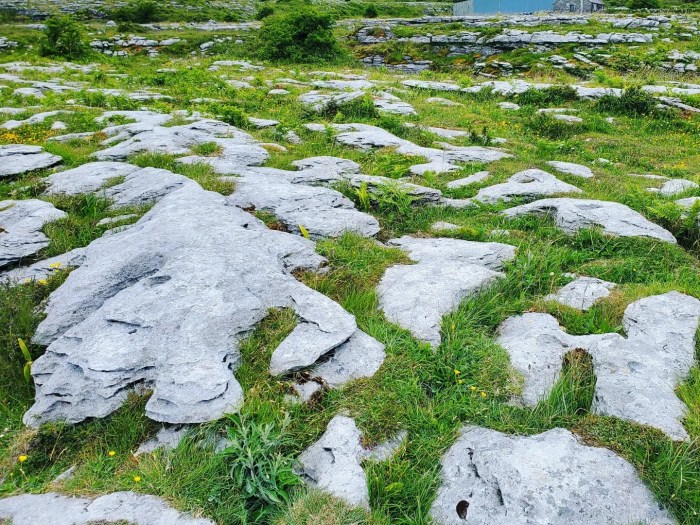
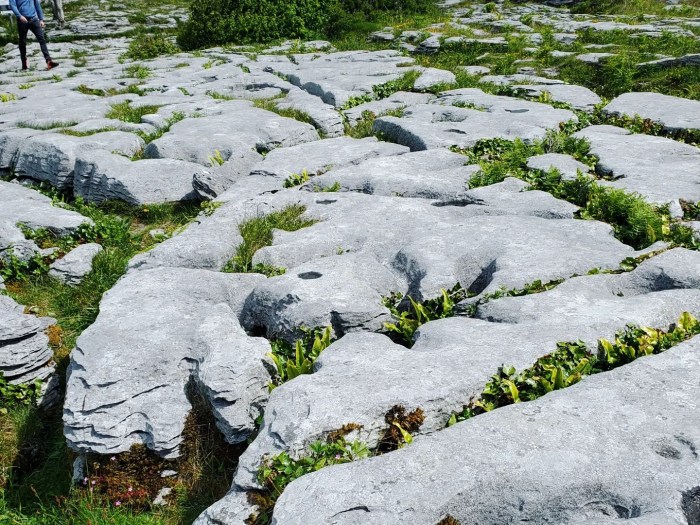
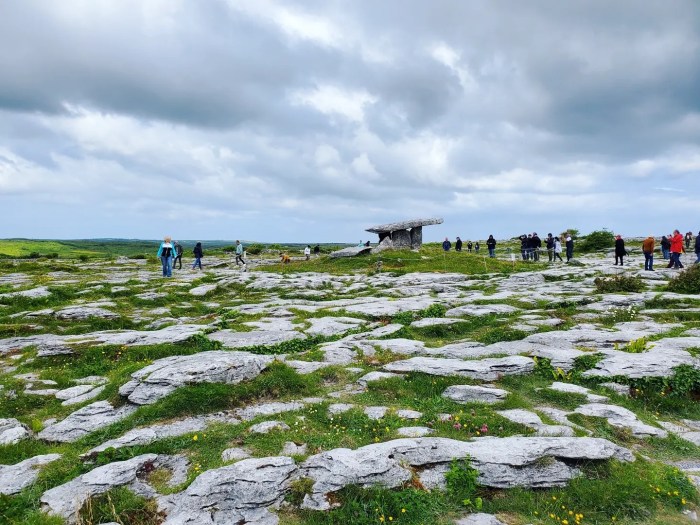
In southwestern Ireland and along its west coast, County Clare is home to The Burren, a region defined by its unbelievable karst landscape. Karst is a limestone bedrock that sprawls out like stony groundcover.
Larger plates of stone give off serious Moon vibes, too.
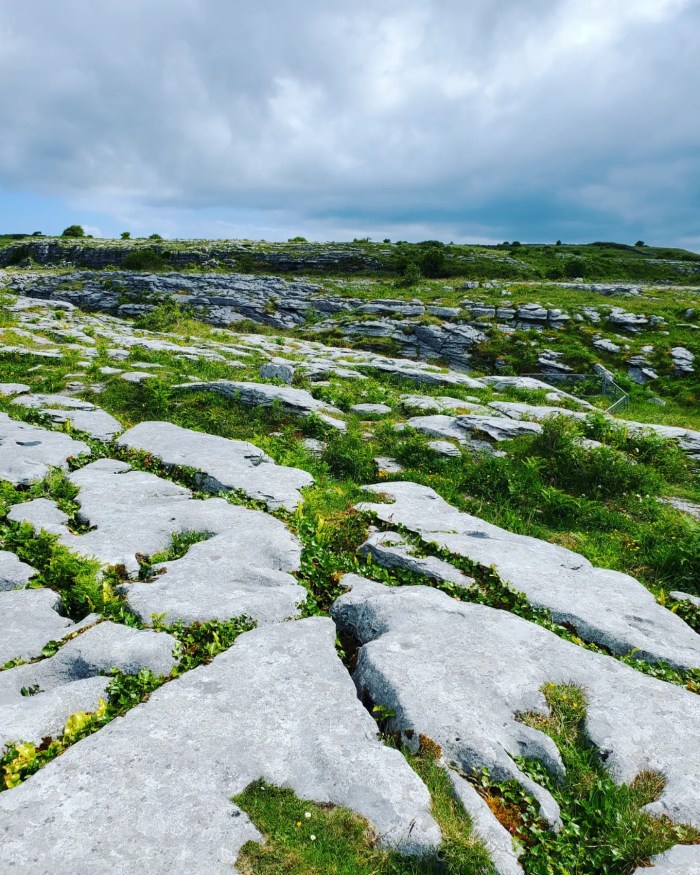
Burren comes from the Irish word Boireann or Boirinn, meaning “a great rocky district.”
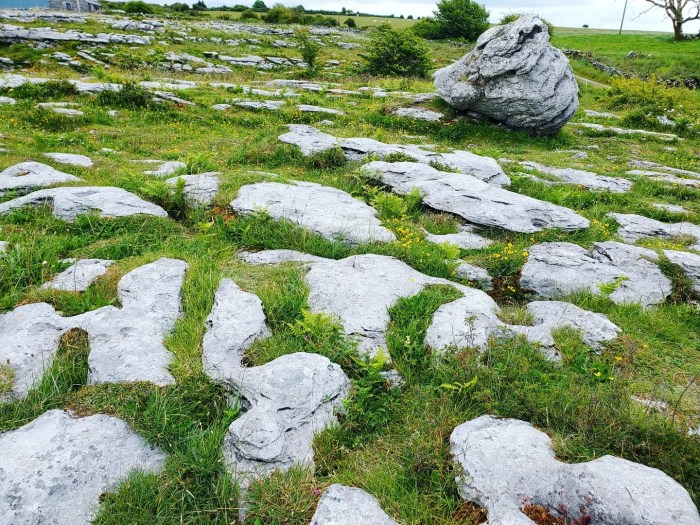
This thick layering of limestone also includes sandstones, mudstones and siltstone.
Visible layers of karst date back to the Carboniferous age, while deeper layers can be traced all the way to the Lower Paleozoic age.
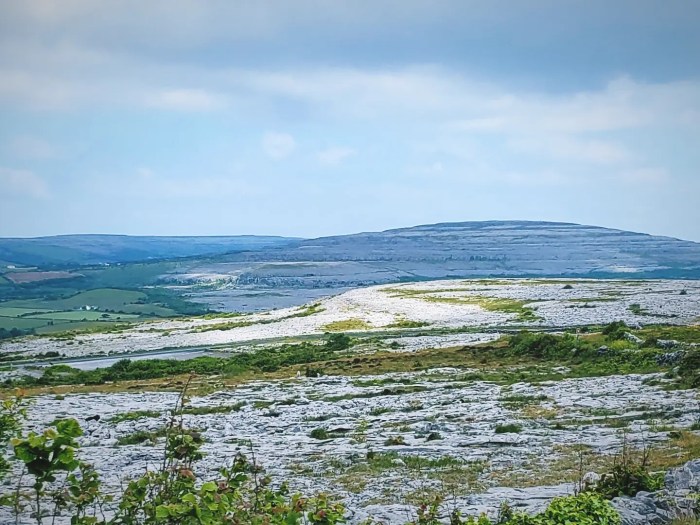
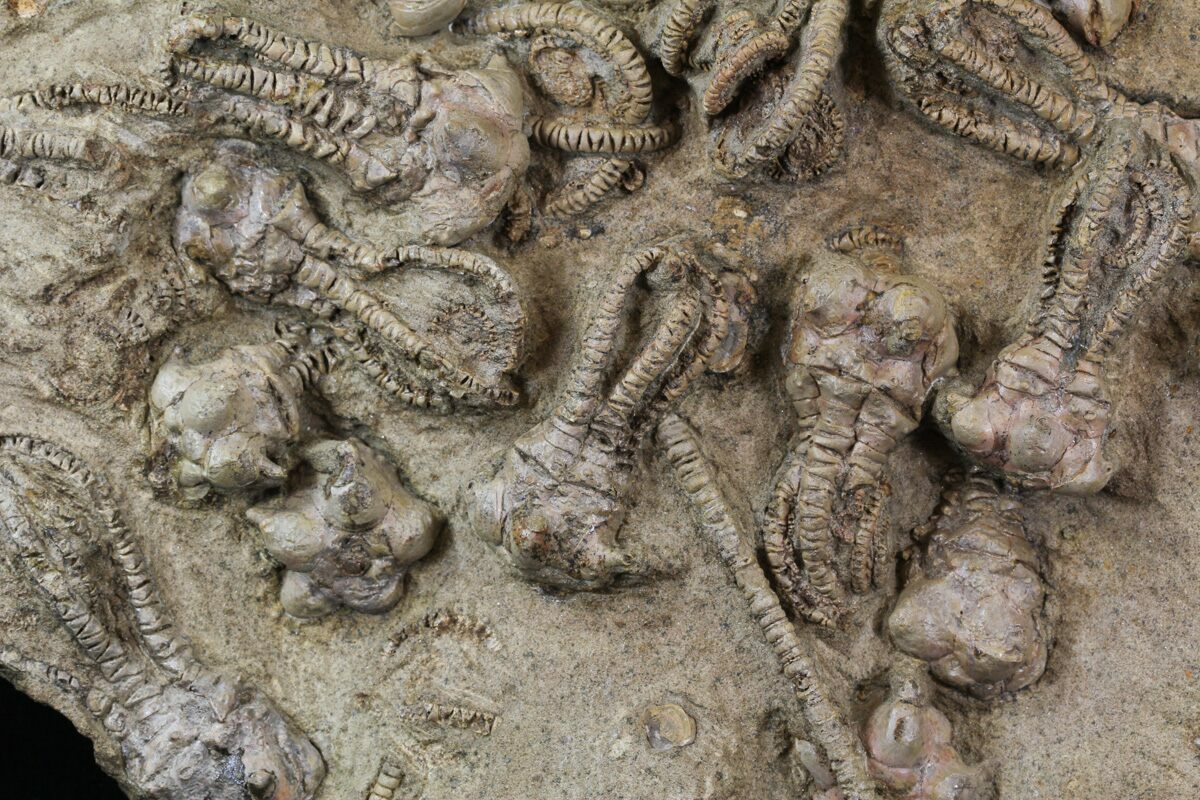
A large portion of the rock slab is over 2,600 feet thick and contains exciting specimens of crinoids, ammonites, coral, and sea urchins embedded in it. You can see an abundance of these fossils standing on the rocky beach in Doolin where you board the cruise ships.
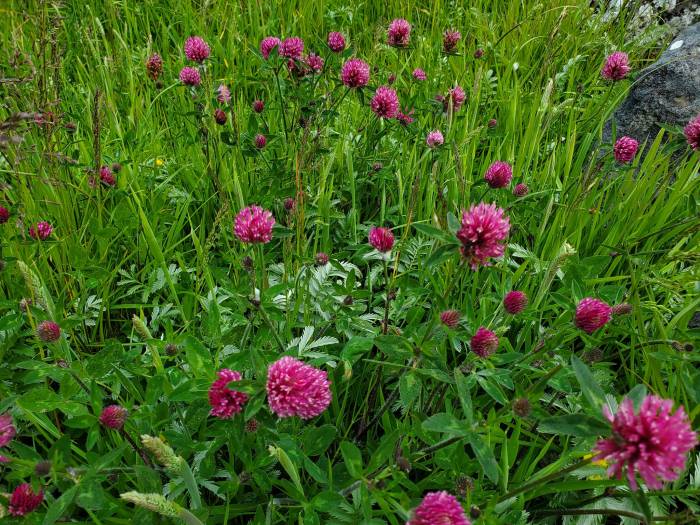
The Burren is situated along Ireland’s Atlantic Coast and Galway Bay. It is well known for its variety of animals and plants found, of all places, in this rocky landscape that both Mediterranean and Arctic/Alpine plants thrive within.
Fossils, unique rock formations, dolmens, steep cliffs, and caves also fill the vast expanse of karst pavement.
Coverage is not completely solid, and you could easily fall through the crevices or snap an ankle if you are not careful.
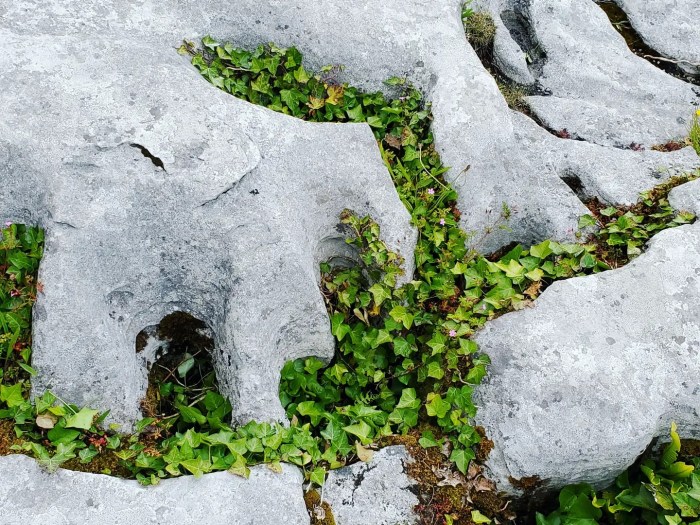
Many places in or near The Burren region overlap both the Burren National Park and the Burren & Cliffs of Moher Geopark.
This Geopark was formed in 2011, is a UNESCO-recognised site, and is part of the Global Geoparks Network (GGN).
BurrenLIFE Programme and Burren Connect (aka B.E.N.) are two awesome organizations that support the Burren’s environment, community, and tourism industry.
THE BURREN NATIONAL PARK
The Burren National Park was created in 1991 and covers only a fraction of the 3,700 acre region. It is the smallest of Ireland’s national parks, but just as exciting to visit as the larger ones.
The Burren and The Burren National Park include the villages of Lisdoonvarna, Corofin, Goft, and Kinvara, as well as historic monuments like Caherconnel Stone Fort and Poulnabrone Dolmen.
A few underrated sites of interest in the park include Doolin Cave, Loop Head Lighthouse, Mullaghmore Hill and Ailladie Cliffs.
POULNABRONE DOLMEN
One of the most popular attractions inside the Burren National Park is the Poulnabrone Dolmen, an ancient portal tomb that has become one of the most iconic archaeological features in the country.
Poulnabrone comes form the Irish term Poll na Brón which can fittingly be translated into “Hole of Sorrows.”
In the 1980s, a team of archaeologists excavated the site and found remains of more than 30 human bodies dated back to a period of around 5,800 years ago, as well as evidence that the site had been used as burial grounds for close to 600 years.
This can be determined by several methods including radiocarbon dating, studying soil strata, etc.
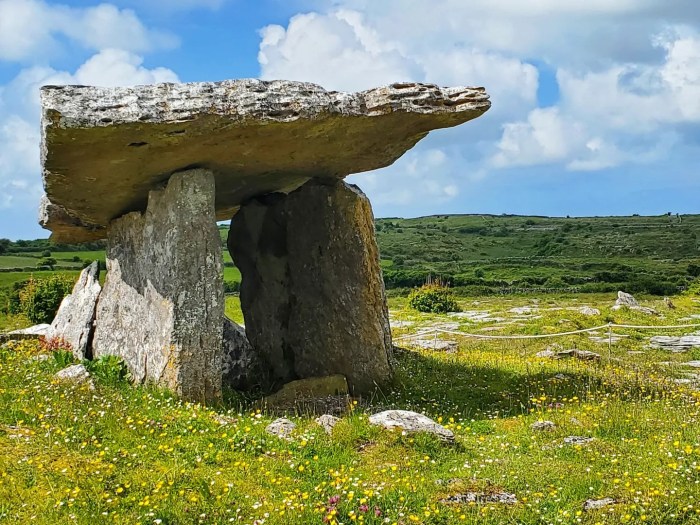
Poulnabrone is Ireland’s oldest dated megalith, consisting of two large portal stones that frame a sloped entrance.
On site, I learned that many of the portal tombs found in County Clare feature capstones that slope westward, while those in other locations around the world usually slope in every direction but west.
The terms “dolmen” and “portal tomb” may be used interchangeably, as both describe a megalithic tomb that contains one single chamber, typically used as a ceremonial site and sometimes as territory markers.
However, the Irish National Monuments Service has restructured the classifications of its known monuments and the terms used to describe them. Soon, if not already, most “dolmens” will be renamed Portal Tombs.
THE BURREN NATURE SANCTUARY & BOTANICAL GARDENS
Just past Poulnabrone is the Caherconnel Stone For, known for its sheepdog demonstrations.
Another 25-30 minutes drive will take you through Bealaclugga and to The Burren Nature Sanctuary & Botanical Gardens in Kinvara.
DOOLIN
Doolin is known for its long-lasting history of traditional Irish music, especially the “West Clare” style that includes concertinas.
There are several festivals that take place here each year to celebrate this unique genre of music.
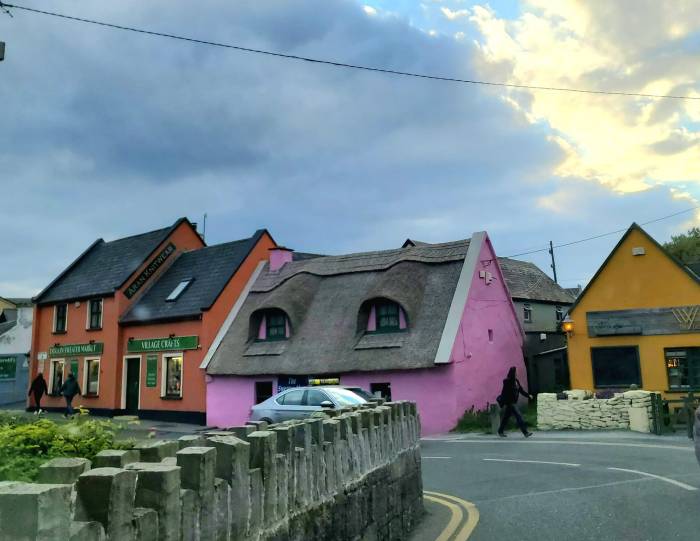
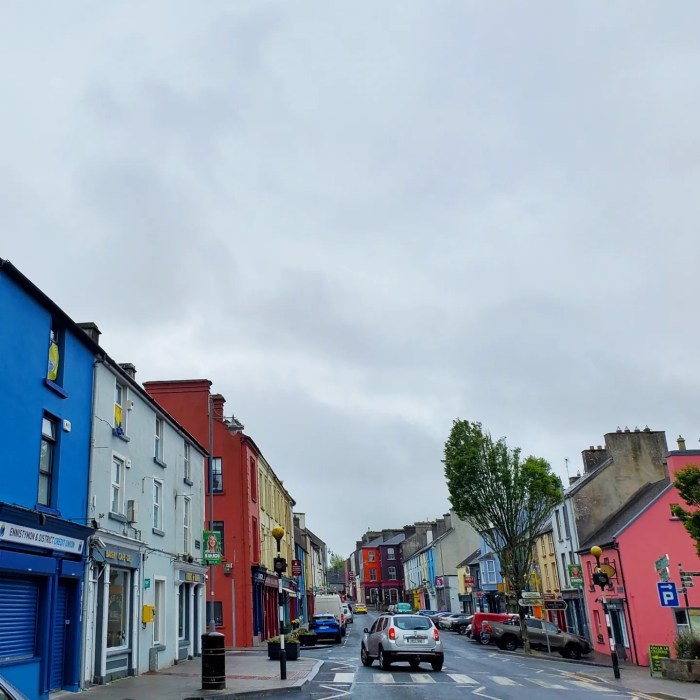
As you enter the village, an iconic, curvy road leads past the many painted shops with slanted roofs.

Many visitors just pass through on the way to the Doolin Pier where you can take a boat cruise to the Cliffs of Moher, but Doolin has lots of pubs and galleries to keep you entertained.
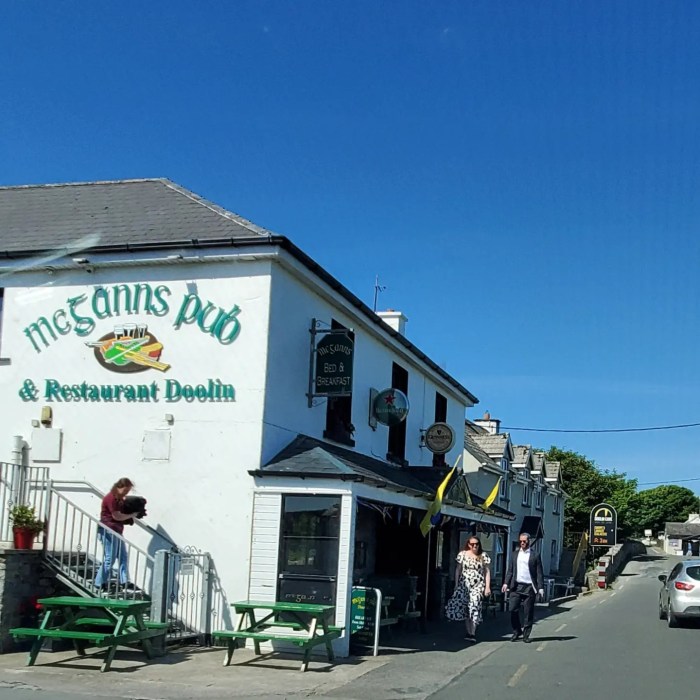
Fitz’s Pub at Hotel Doolin was our pick for dinner. I like their outdoor patio facing the main drag through Doolin, and that they have live music playing every night.
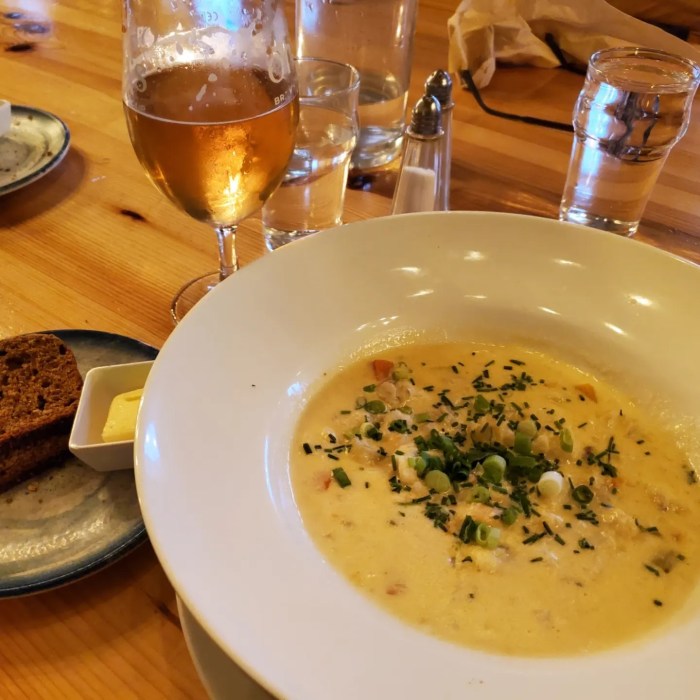
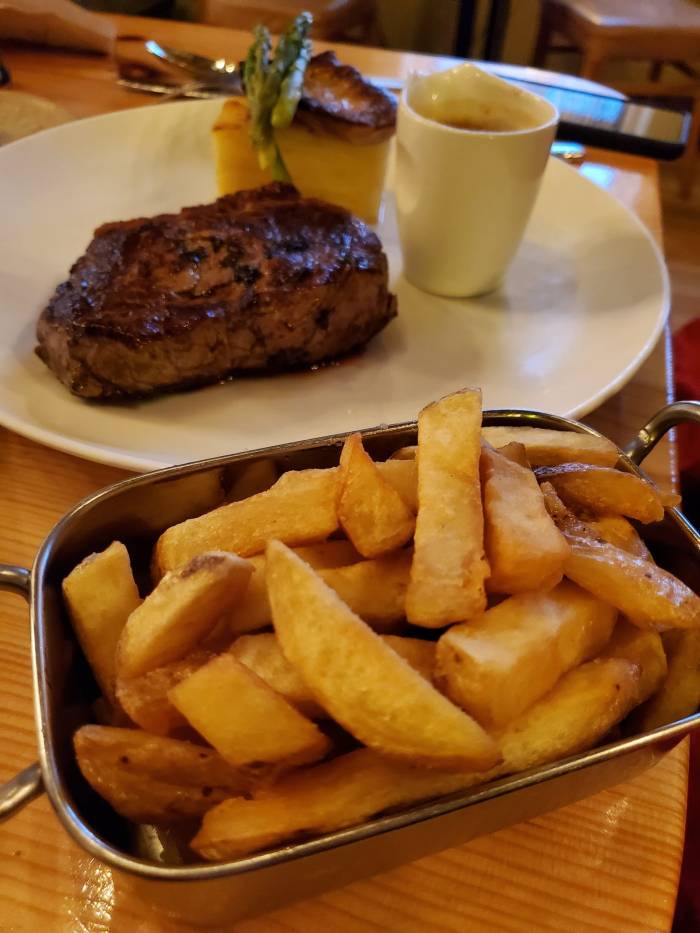
The seafood chowder and brown bread is divine. We also tried the steak, scalloped potatoes, and hand-cut chips (fries).
DOOLIN PIER
The rocky beaches of Doolin Pier are full of limestone boulders that you can climb around or sit on.
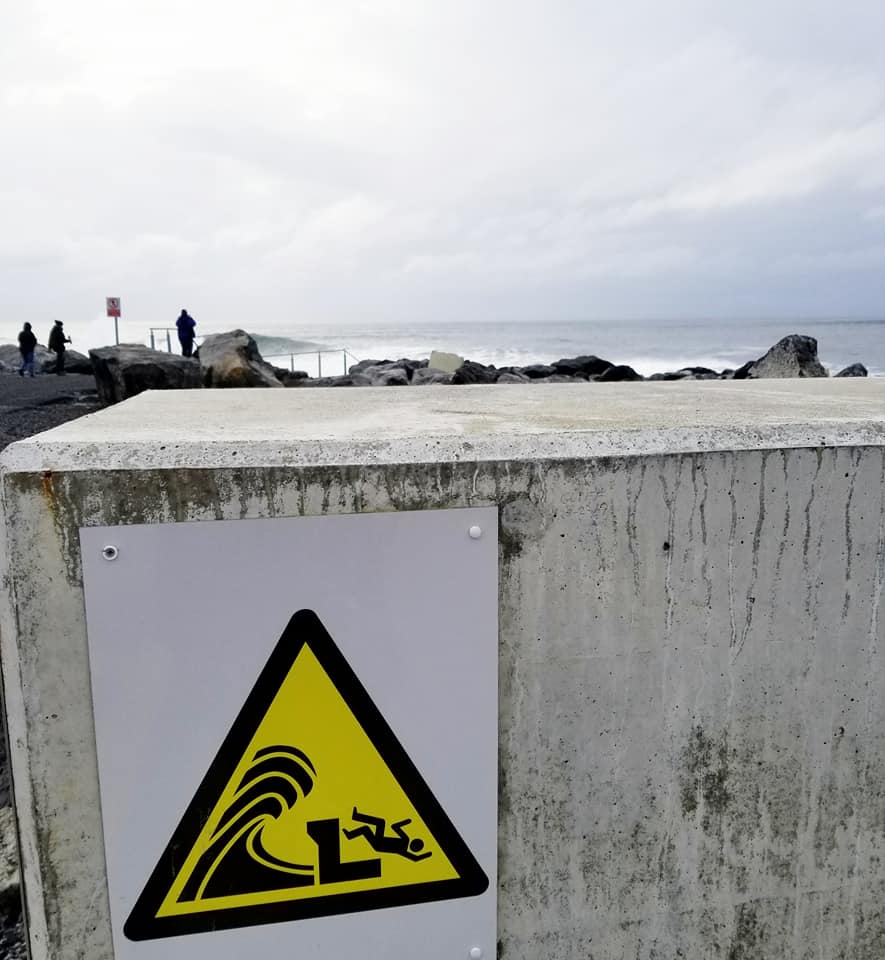
I felt completely at peace with the cool weather, grey sky, crashing waves, and furious winds, but you must be careful not to get too close to the edge of the rock walls.
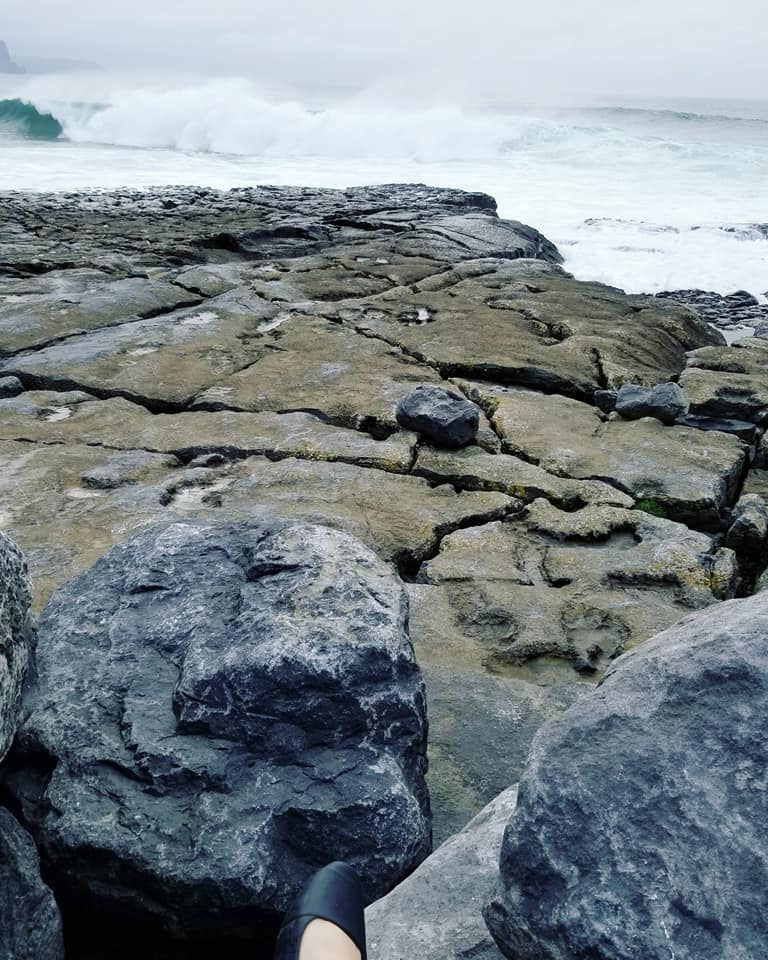
The limestone formations here are considered to be the youngest in the region, and they are full of strange impressions and crinoid fossils.
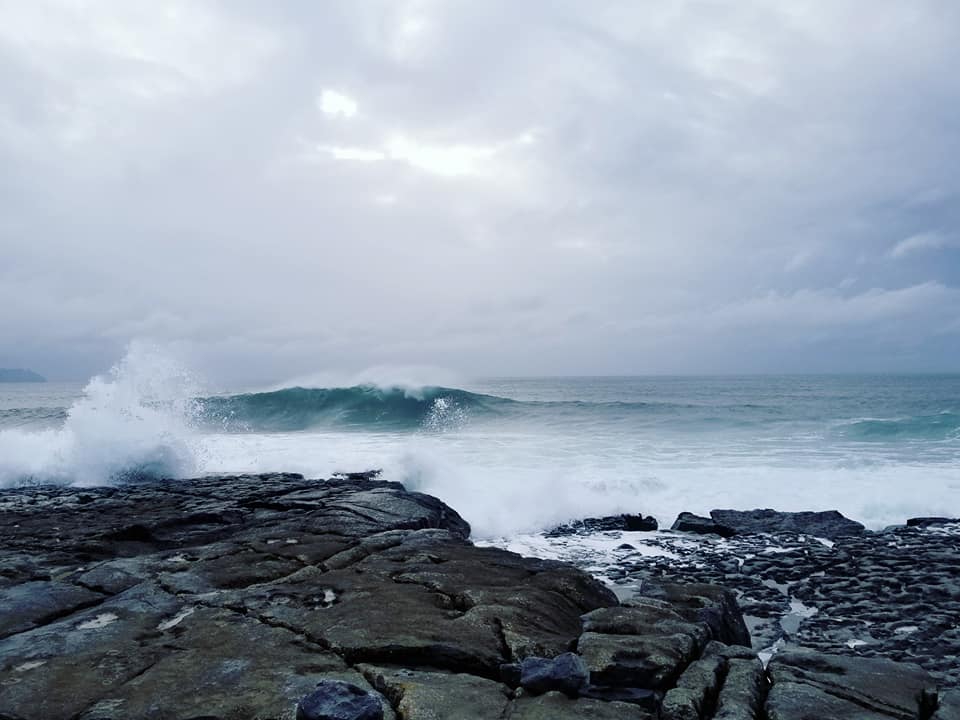
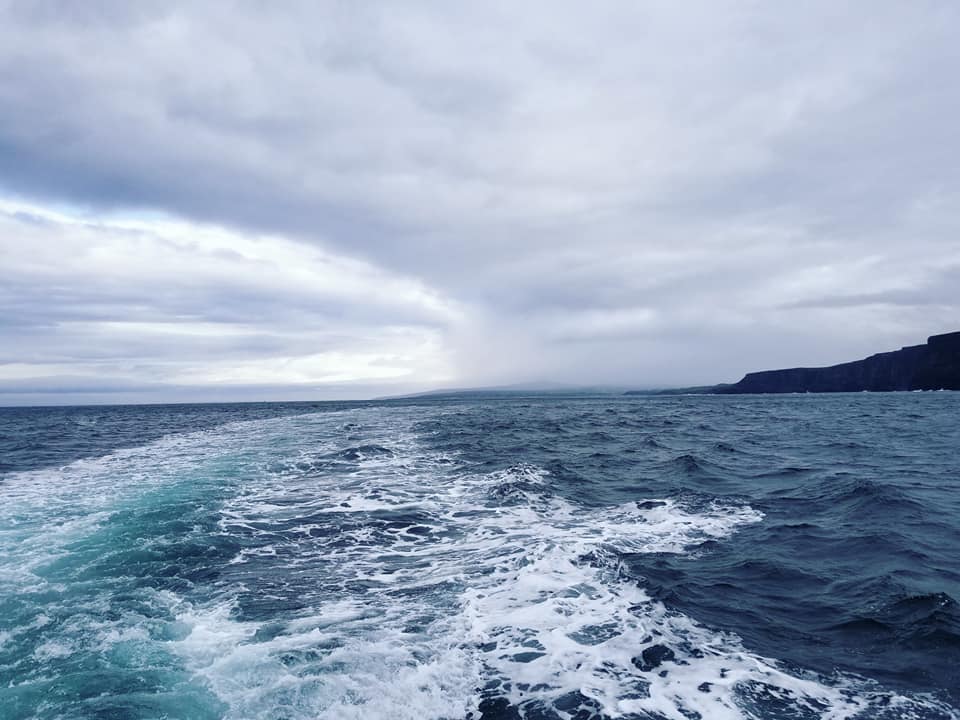
Out on the water it was frigid, and the wind was so heavy it kept knocking the breath out of us, but I loved every second of it.
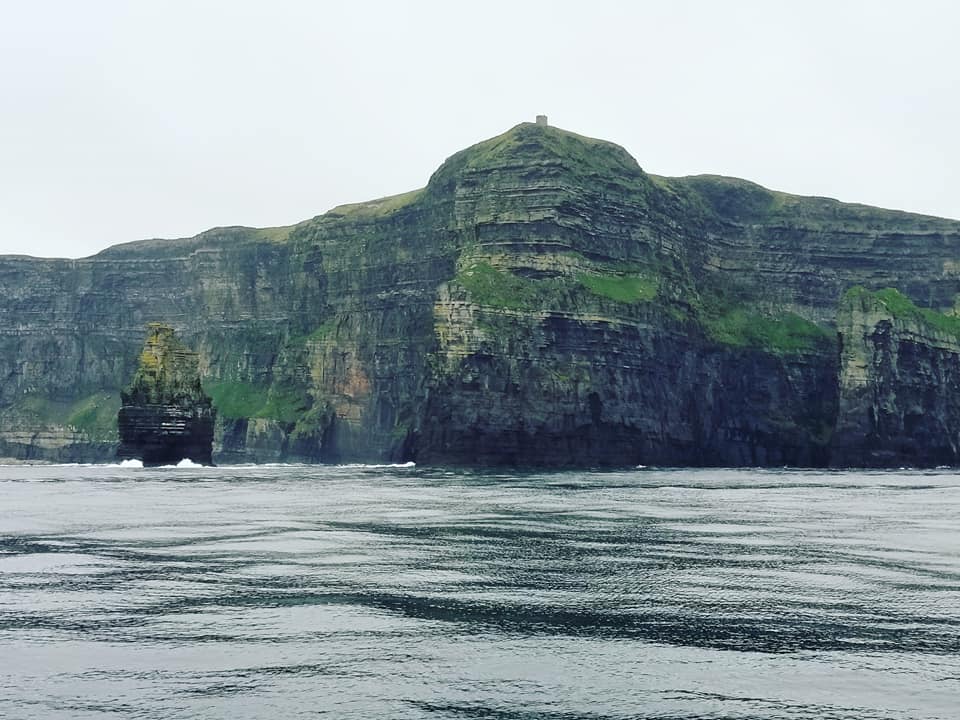
Our ship took on around two dozen people from all over the world, and when the cliffs came into view everyone cheered.
The detached rock tower is known as Hag’s Head.
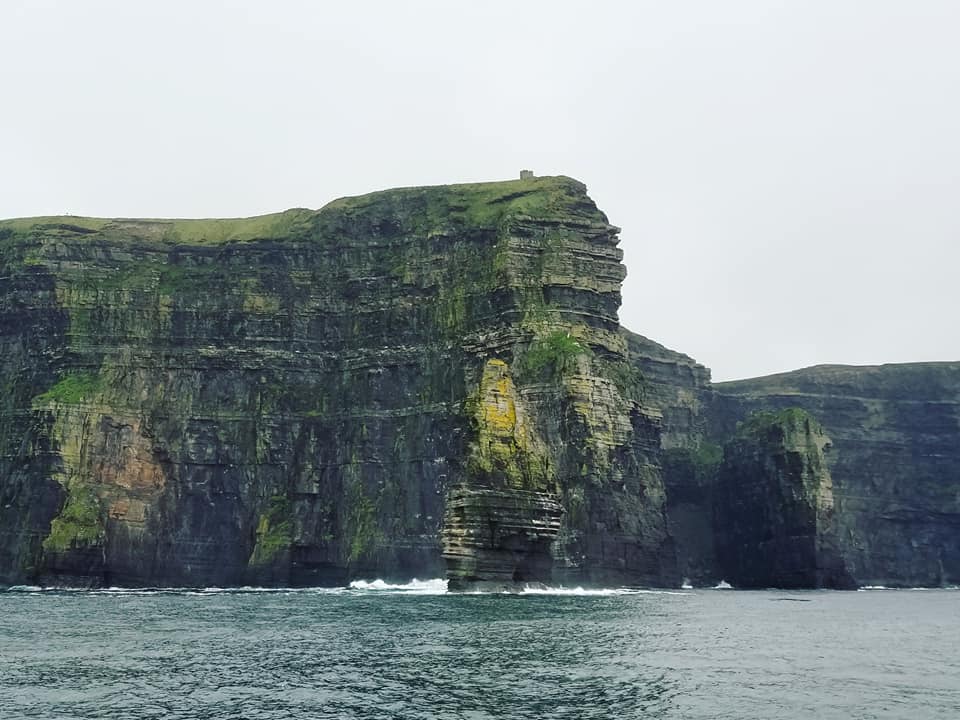
From the top of the cliffs you can see the Aran Islands and the Twelve Bens mountains of Connemara in the distance.
CLIFFS OF MOHER
Taking an Atlantic Cruise along the Cliffs of Moher was my most anticipated part of the trip.
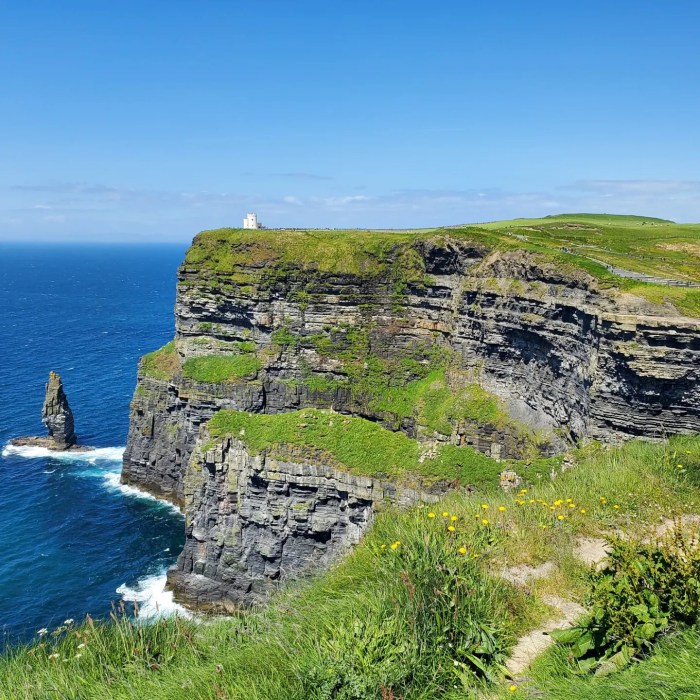
Unfortunately we only had enough time to take the cruise before moving on, but I recently went back to go up to top of the cliffs.
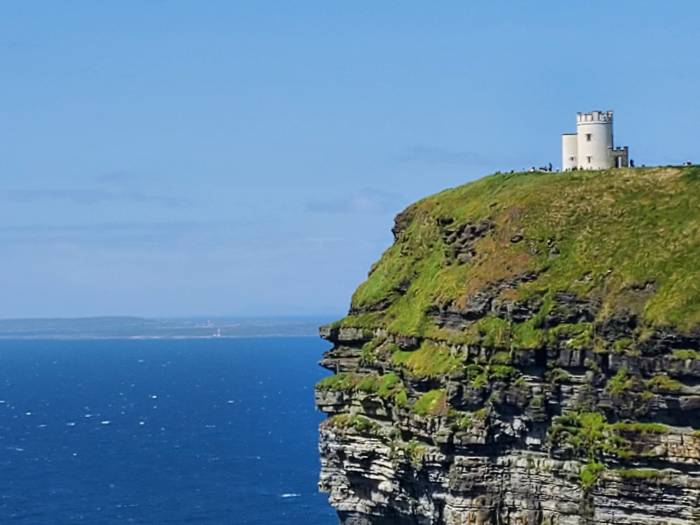
The limestone cliffs stand nearly 400 feet above sea level and are an extension of The Burren.
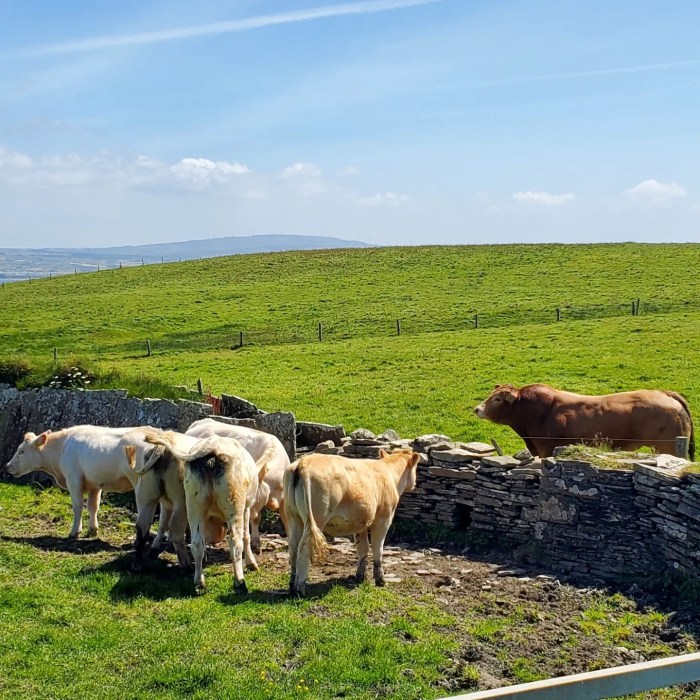
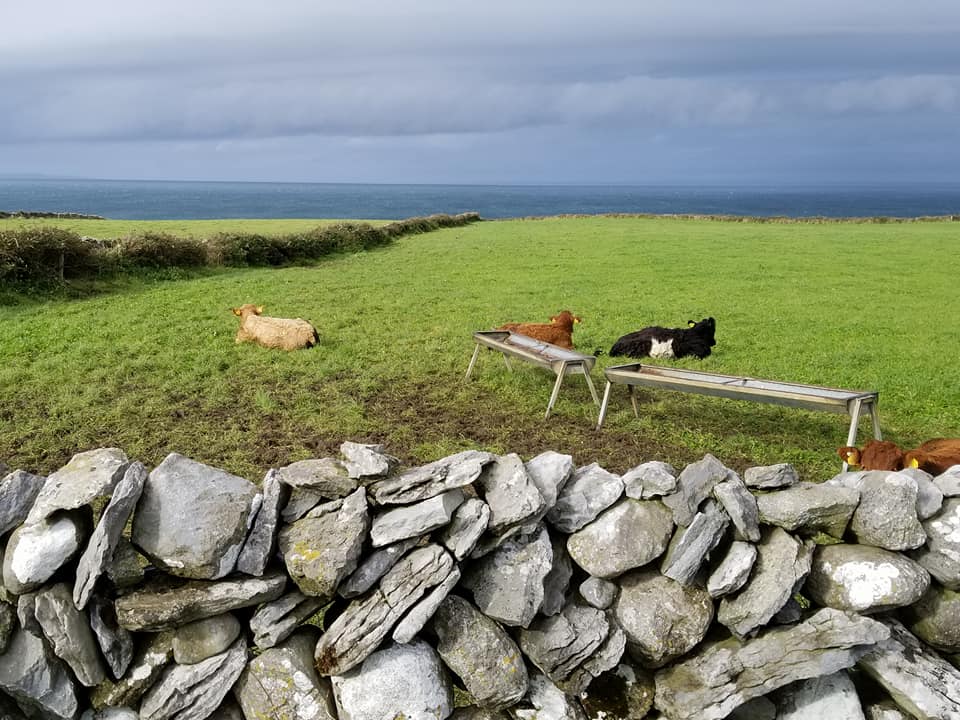
I had no idea until then that there is a large cow pasture at the top of the hike. Those cows do not have a clue how lucky they are to live peacefully in a place like that.
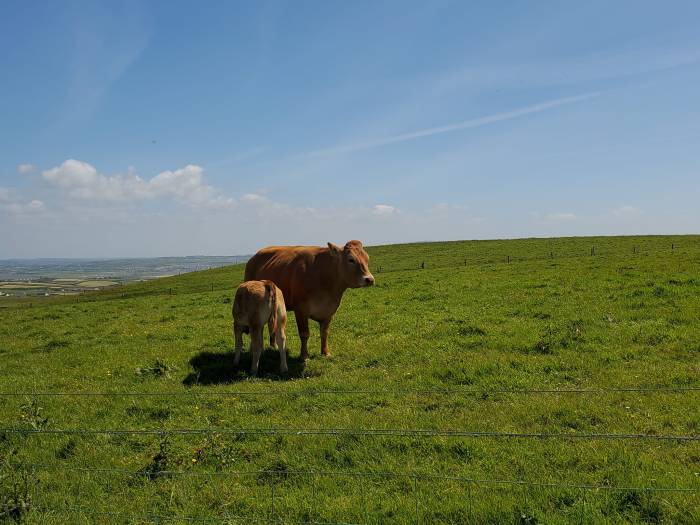
I cackled like a maniac when someone started calling this the “Cliffs of MOO-her” and am once again laughing into tears as I type this.
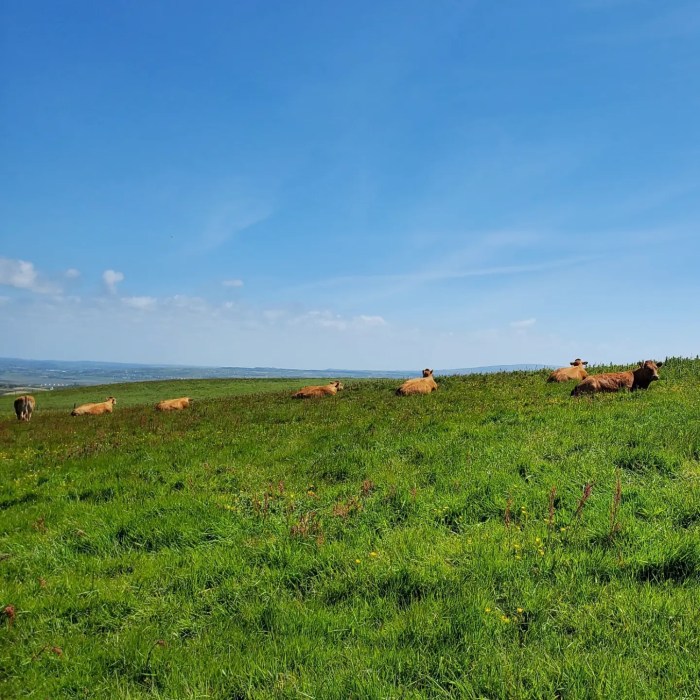
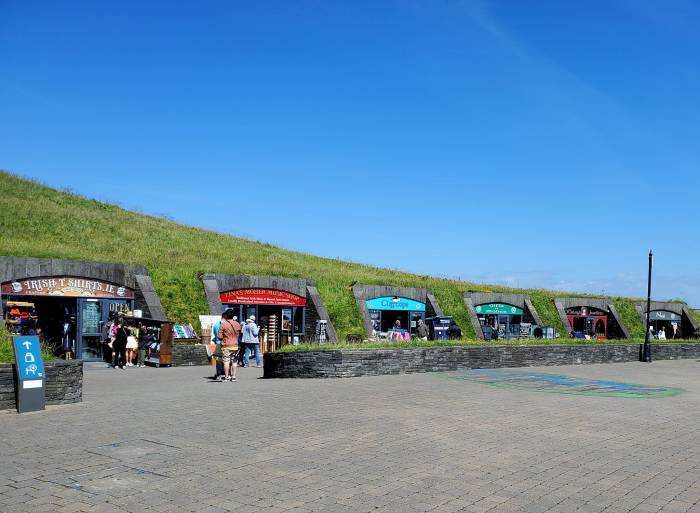
Be sure to check out some of the cool hobbit style shops there too.
DOONAGORE
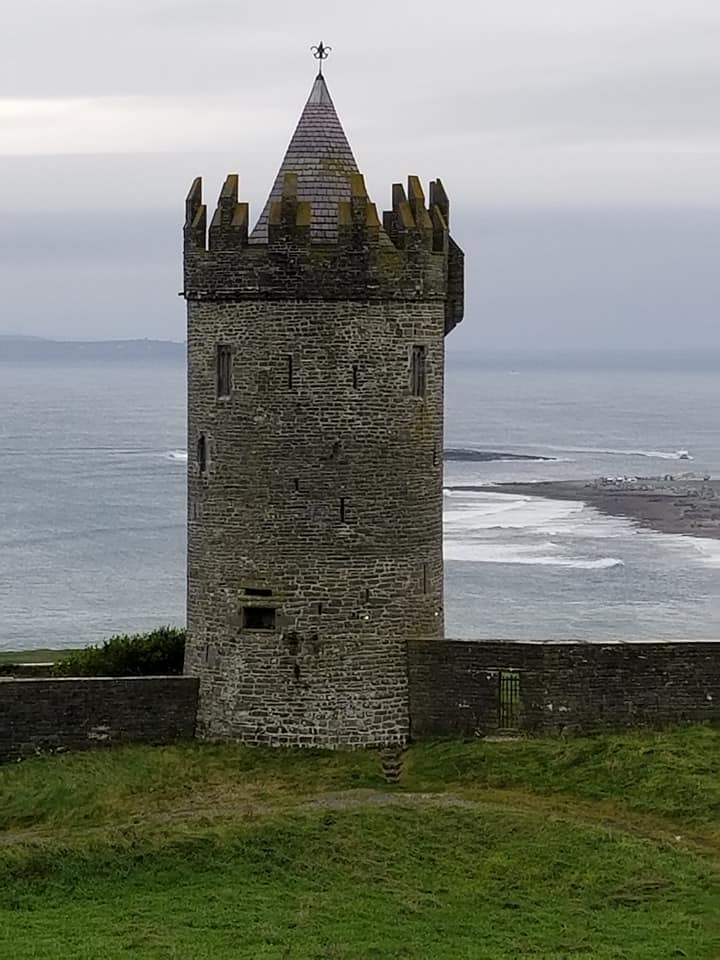
Just outside the main center of Doolin, we passed a curious tower and pulled over to investigate.

Doonagore is a 16th century castle named after Dún na Gabhair, which is a fort on top of a huge round hill. It is a private residence so we could not visit it, but we enjoyed the walk down and the view of the Atlantic.
WILD ATLANTIC WAY
The Cliff Coast segment of the WAW also includes the Aran Islands, a cluster of three islands that vary in size. Inishmore Island is the largest, known around the world for its collection of religious and mythological monuments. This is the setting of Martin McDonagh’s The Lieutenant of Inishmore.
Inishmann Island is the middle island, and it is the least populated, least visited, and most serene of the three.
Inisheer Island is the smallest island, basically a fishing village full of bars with live music. It is closest to the mainland and has the most prominent beach party vibes of the three islands.
BANSHEES OF INISHERIN
I was disappointed after watching the film The Banshees of Inisherin, mostly because it seemed slow and unremarkable to me, but secondly because Inisherin is a fictional place.
It was not filmed on either of the real islands or in another location in County Clare called Inisheher, which is a pity for anyone who likes to visit film locations.
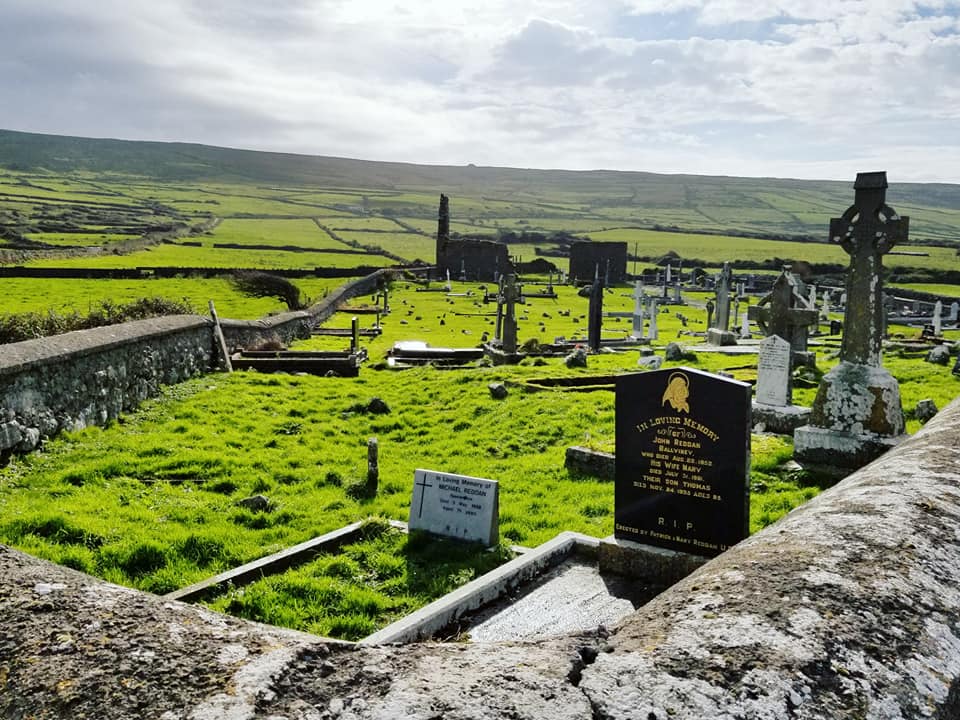
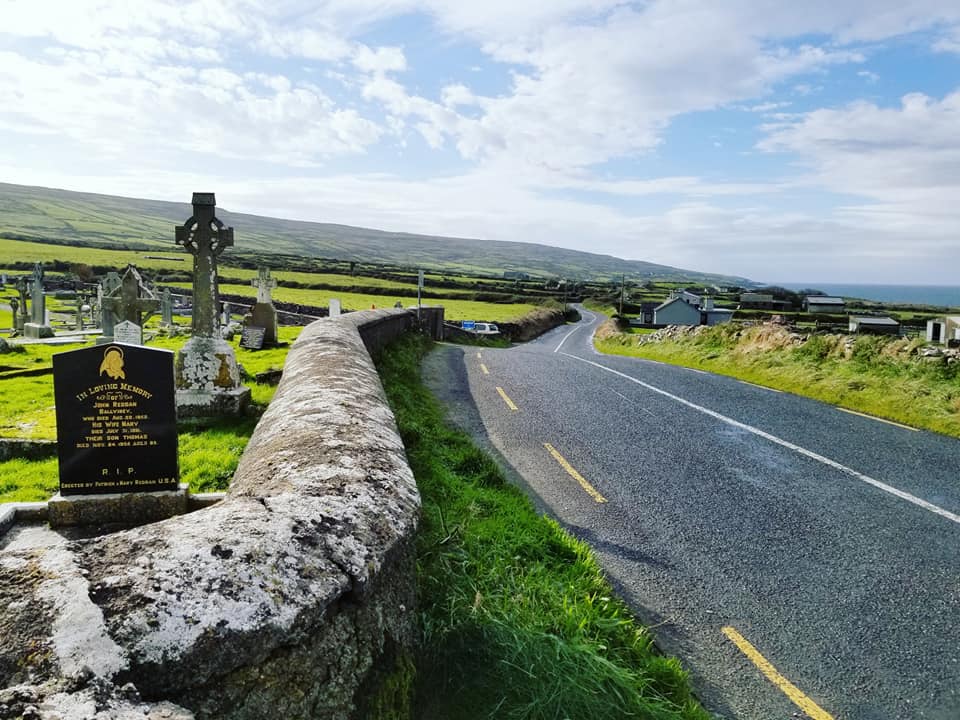
We decided against a boat trip to the Aran Islands because our sights were set on a cruise to the Cliffs of Moher that same day, but the rest of the journey was full of magical scenes like this cemetery and dairy farm.
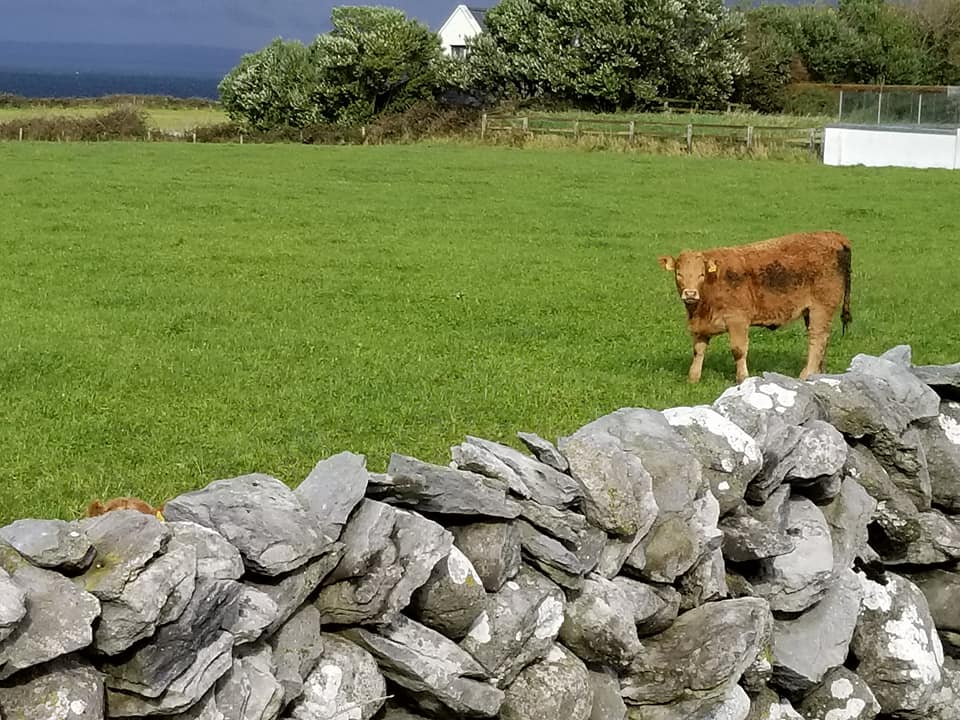
We had followed the Wild Atlantic Way from Galway into Doolin, and beyond.
RINGFORTS & RUINS
County Clare is flush with ringforts and ruins of old castles, monasteries, and abbeys. You can see structures like the one below everywhere you look. It’s like most people have a castle or something ancient in their yard. No big deal.

SMALL TOWNS
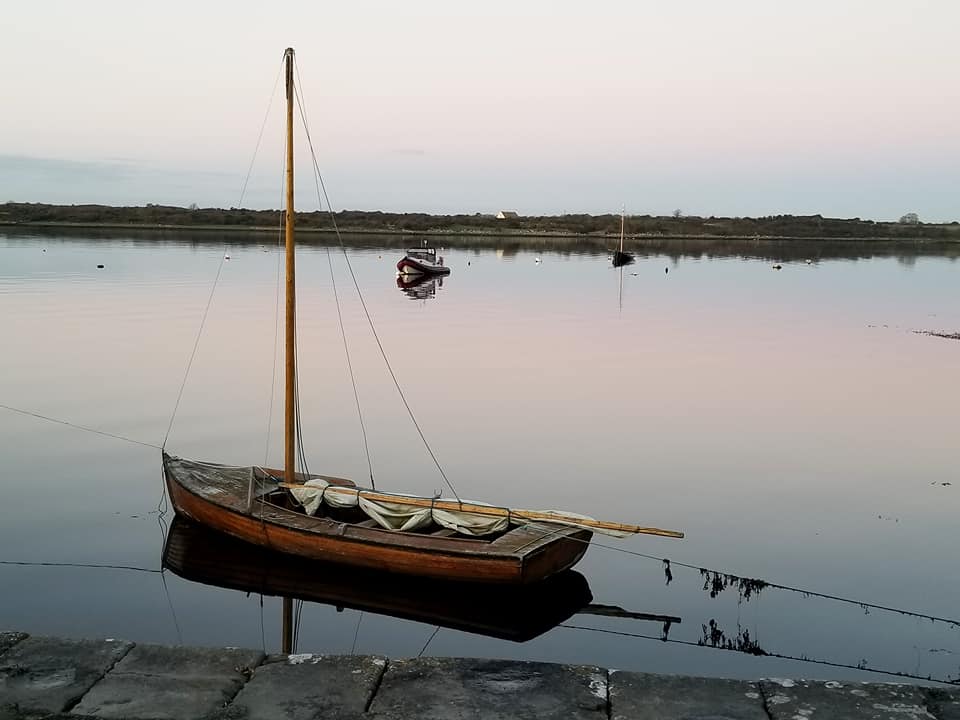
County Clare has some adorable small towns around The Burren including Lisdoonvarna, Ennistymon, and Miltown Malbay.
On my first trip to Ireland, my best friend and I spent a few days traveling a route from County Galway and Renvyle down through Kinvara, Bealaclugga, Bell Harbour, and Ballyvaughan. Check out that blog to read more about our journey through those towns.
LISDOONVARNA
Lisdoonvarna was part of a former Gaeltacht and is a historical spa town in The Burren, first opening its hot springs to the public in 1845.
The springs were on private property owned by a local family so they stayed rustic for many decades.
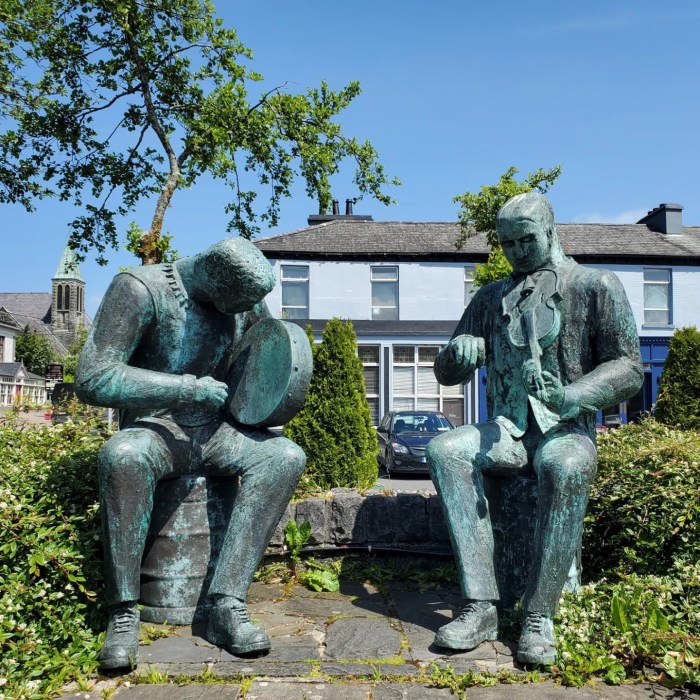
Each September, the month-long Matchmaking Festival takes place in Lisdoonvarna.
Hopeful romantics from all over the globe attend, looking for a partner and trusting their fate to the elected town matchmaker whose family has been hand-selecting new couples for several generations.
Everyone else goes for the live music, dancing, street food, and other festivities.
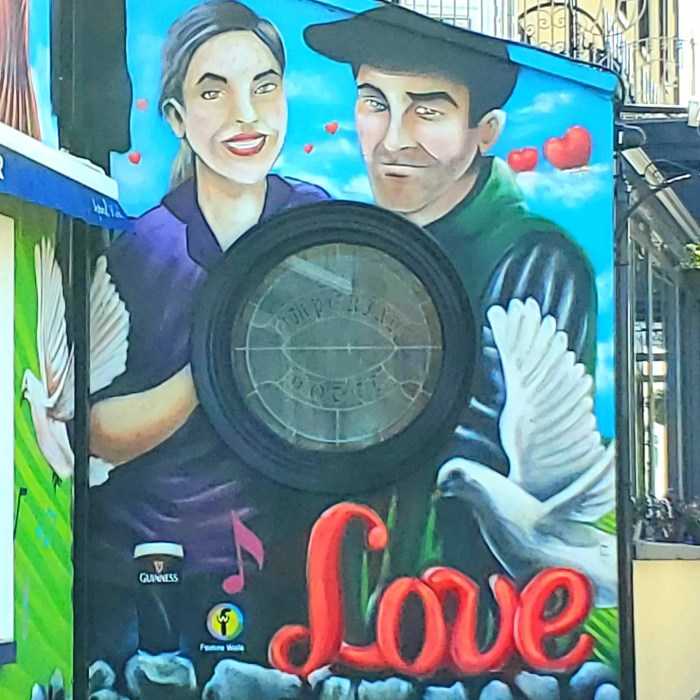
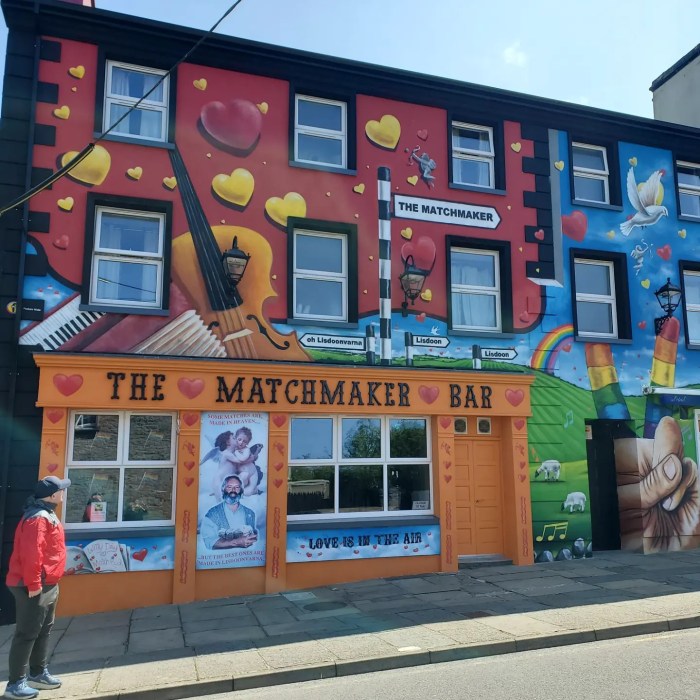
The Matchmaker Bar was the festival’s landmark location, but it has been closed for some time to house Ukrainian refugees. You can still visit and pose with the lively mural on its exterior.
Lisdoonvarna has an impressive local food scene for such a tiny town.
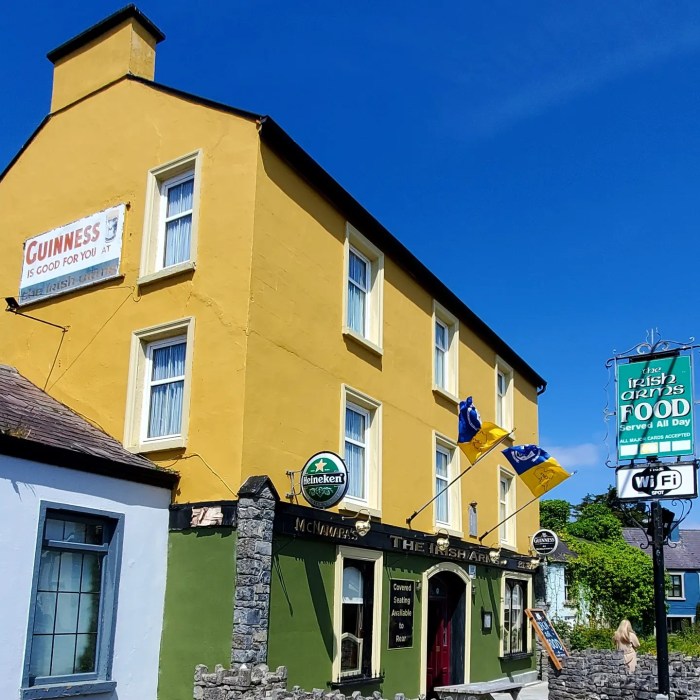
The Wild Honey Inn has the distinction of being the only dining pub in Ireland to receive the Michelin star, and the town hosts Ireland’s annual Burren Slow-Food Festival.
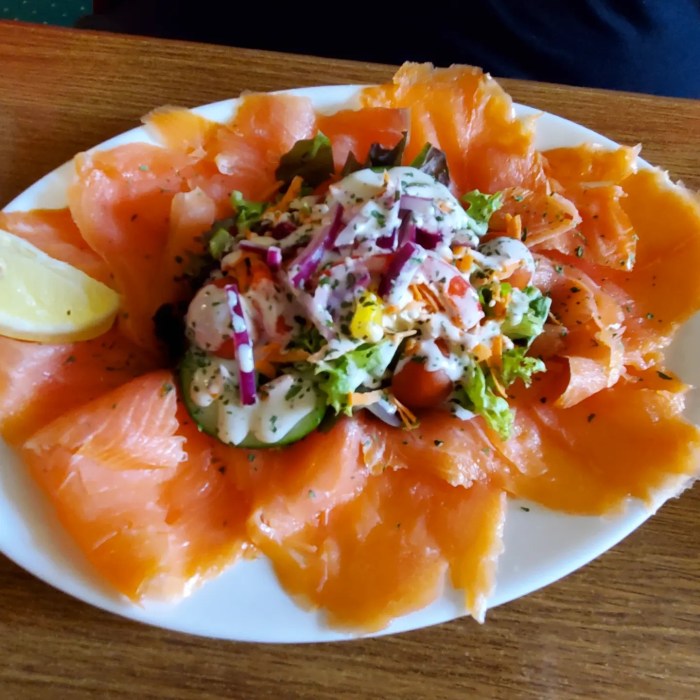
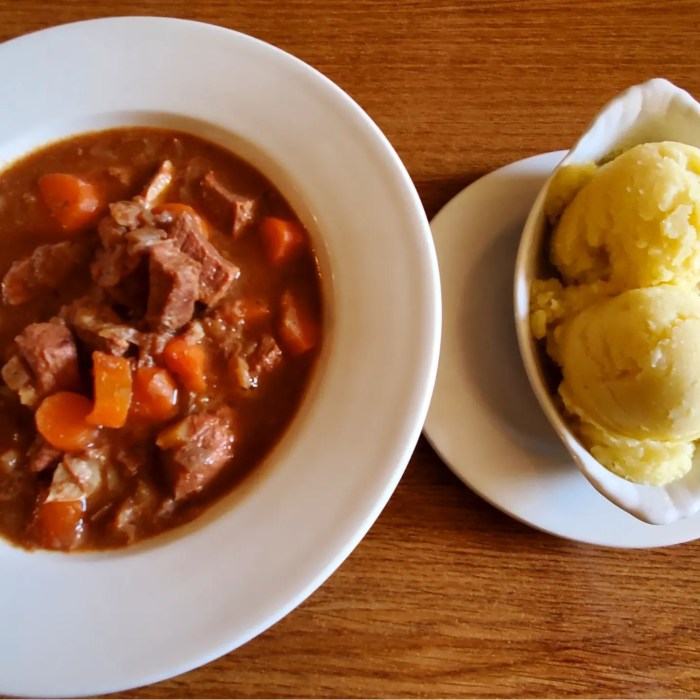
We had a wonderful lunch of smoked salmon and Irish stew at The Irish Arms.
ENNISTYMON
Ennistymon is officially called Ennistimon, but all the maps and even the locals spell it with a “y.”
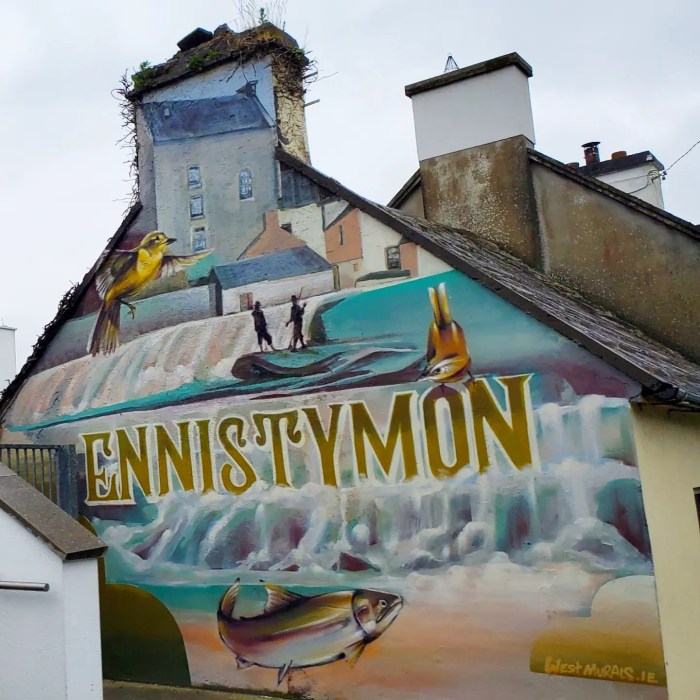
My favourite part of Ennistymon is that the River Cullenagh flows into the center of town and creates striking rapids. It becomes the River Inagh beyond Ennistymon.
These falls are so powerful that the adjacent Falls Hotel is mostly, and nearly completely now, ran by its hydroelectric turbine.
Unfortunately it was raining substantially and we did not stop to take photos of it this time.
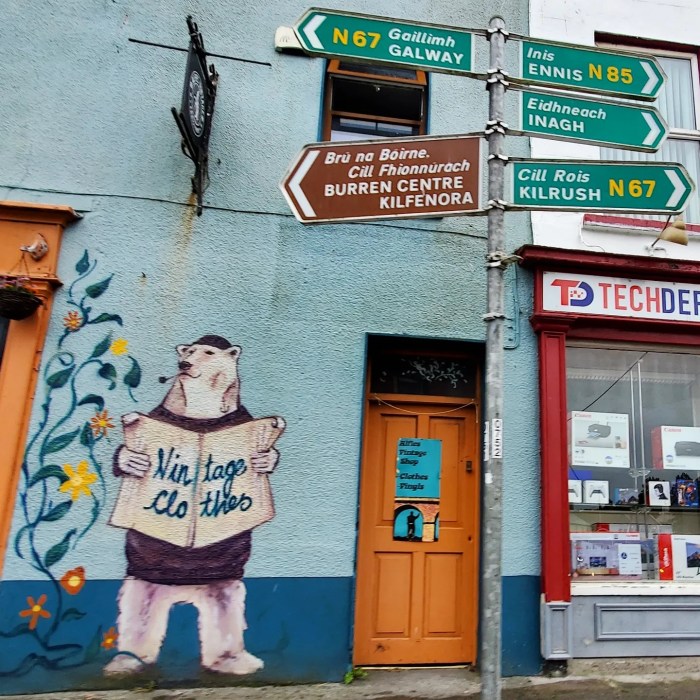
Like in Doolin, you can find a live traditional Irish band playing somewhere every night of the week.
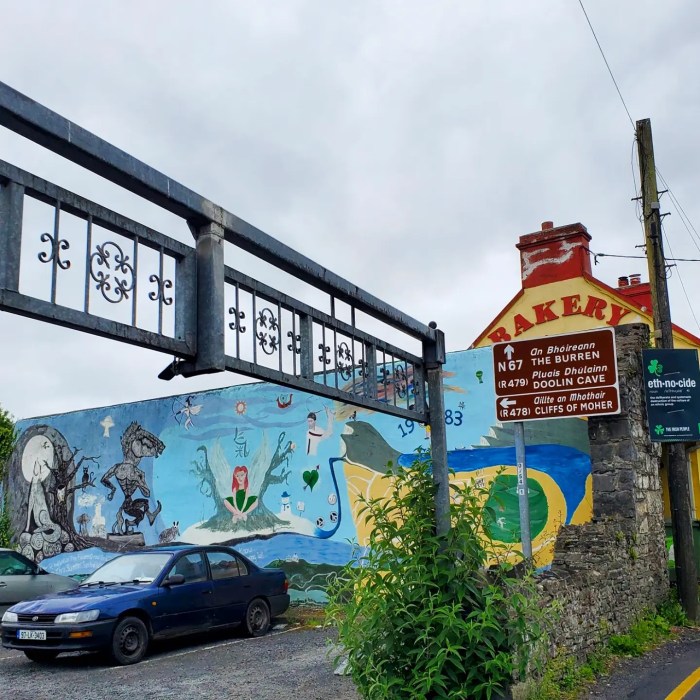
Most of the shops in town are locally owned, not a chain, and there are frequent festivals centered around food, art, and music.
MILTOWN MALBAY
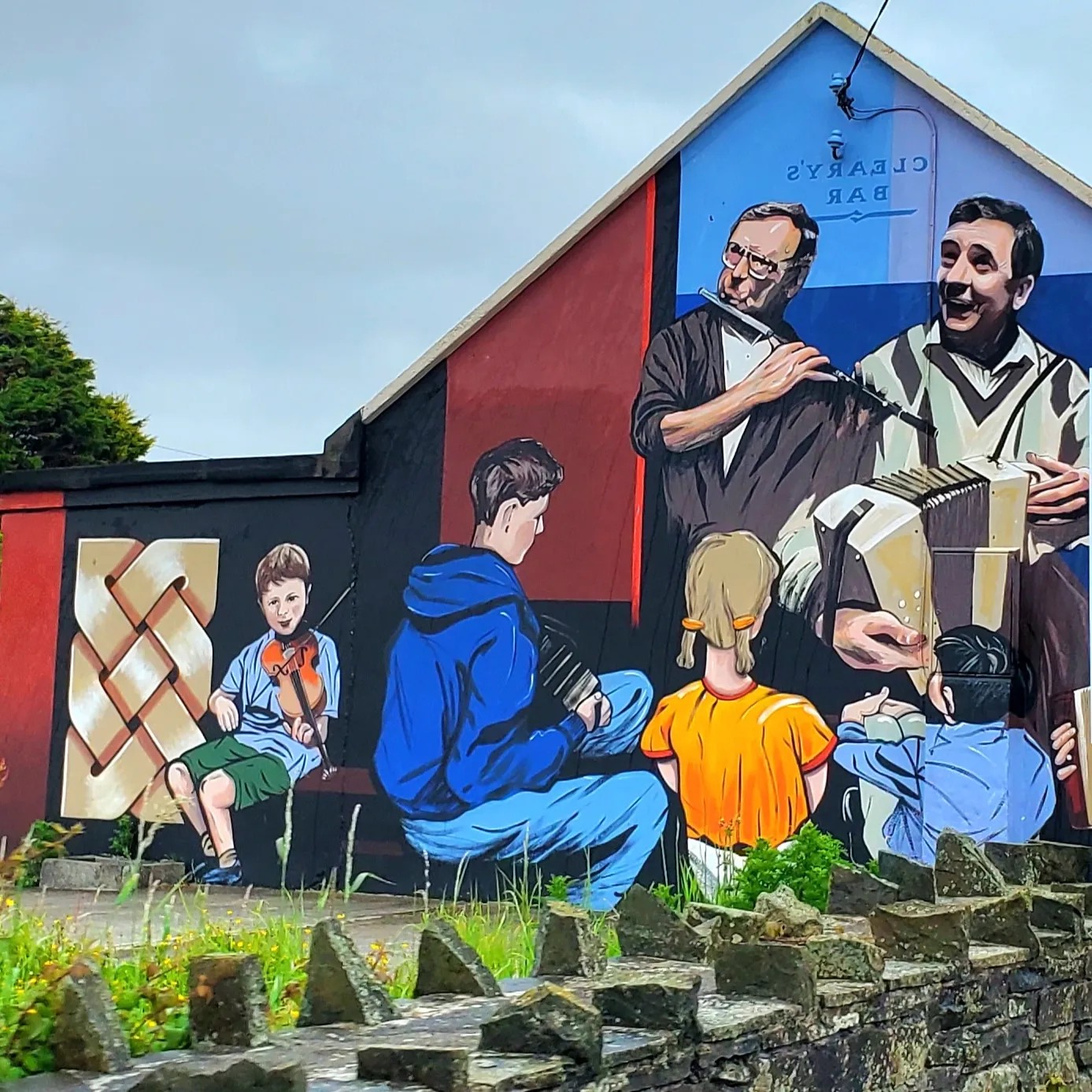
Full disclosure, we did not have the time to stop and walk around in Miltown Malbay, except for me to take a photo of this giant mural on the side of Cleary’s Bar.
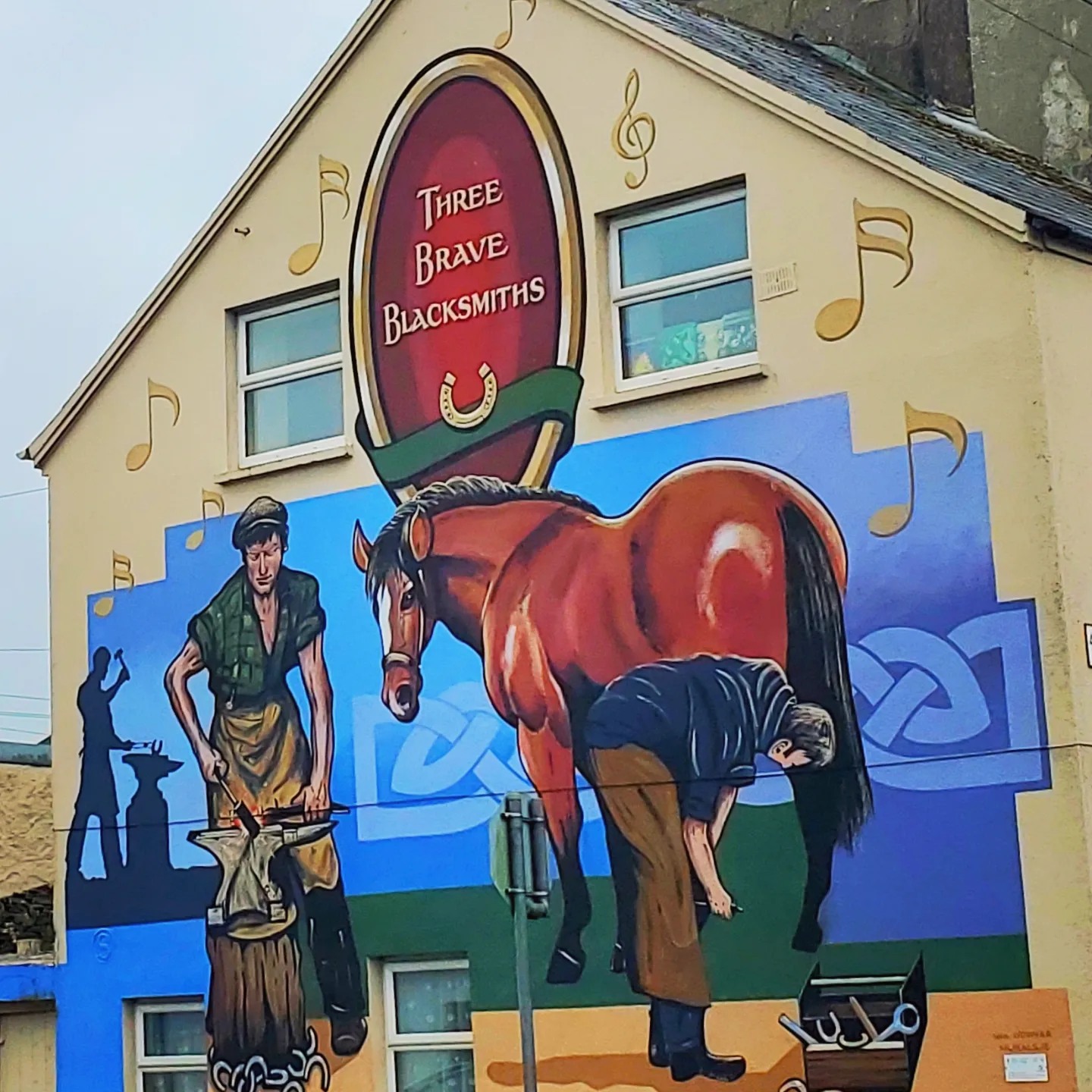
“Three Brave Blacksmiths” is a famous ode to County Clare, and this mural is an ode to that song. Another panel celebrates the citizens of Miltown Malbay and their continuation of traditional Irish music.
We also spotted this statue below of Willie Clancy, namesake of Ireland’s largest traditional music summer school.
His likeness can be seen here playing the uilleann pipes, which are situated across one’s elbows instead of having pipes to the mouth. They have a sound very similar to Scottish bagpipes, but less grating.

SHANNON FERRY
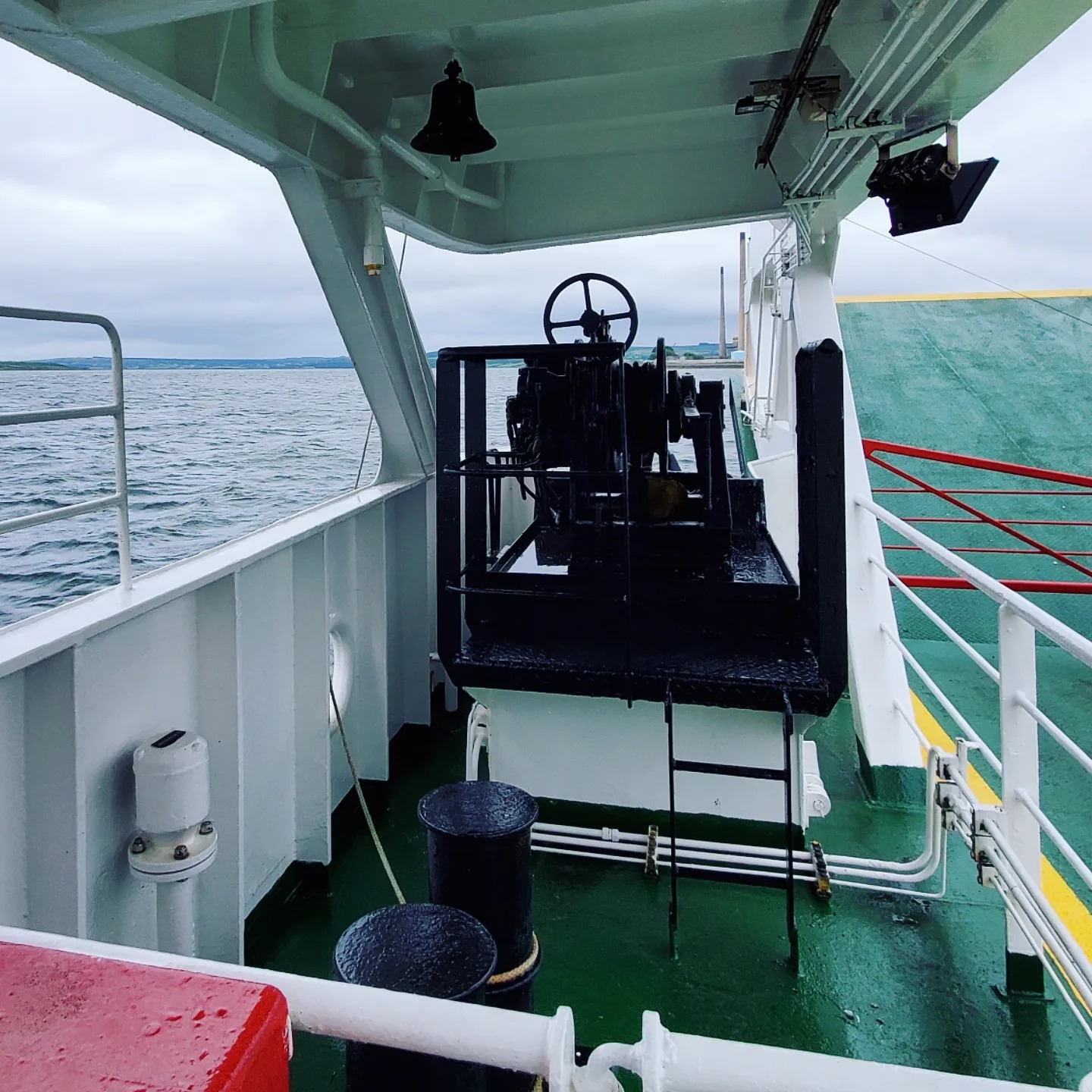
From Miltown Malbay, we drove to Killimer and then took the Shannon Ferry across the Shannon estuary from Killimer to Tarbert.
You can drive your car onto the ferry and park, then take in the views. This 20-minute cruise also saved us a few extra hours of driving the long route on land.
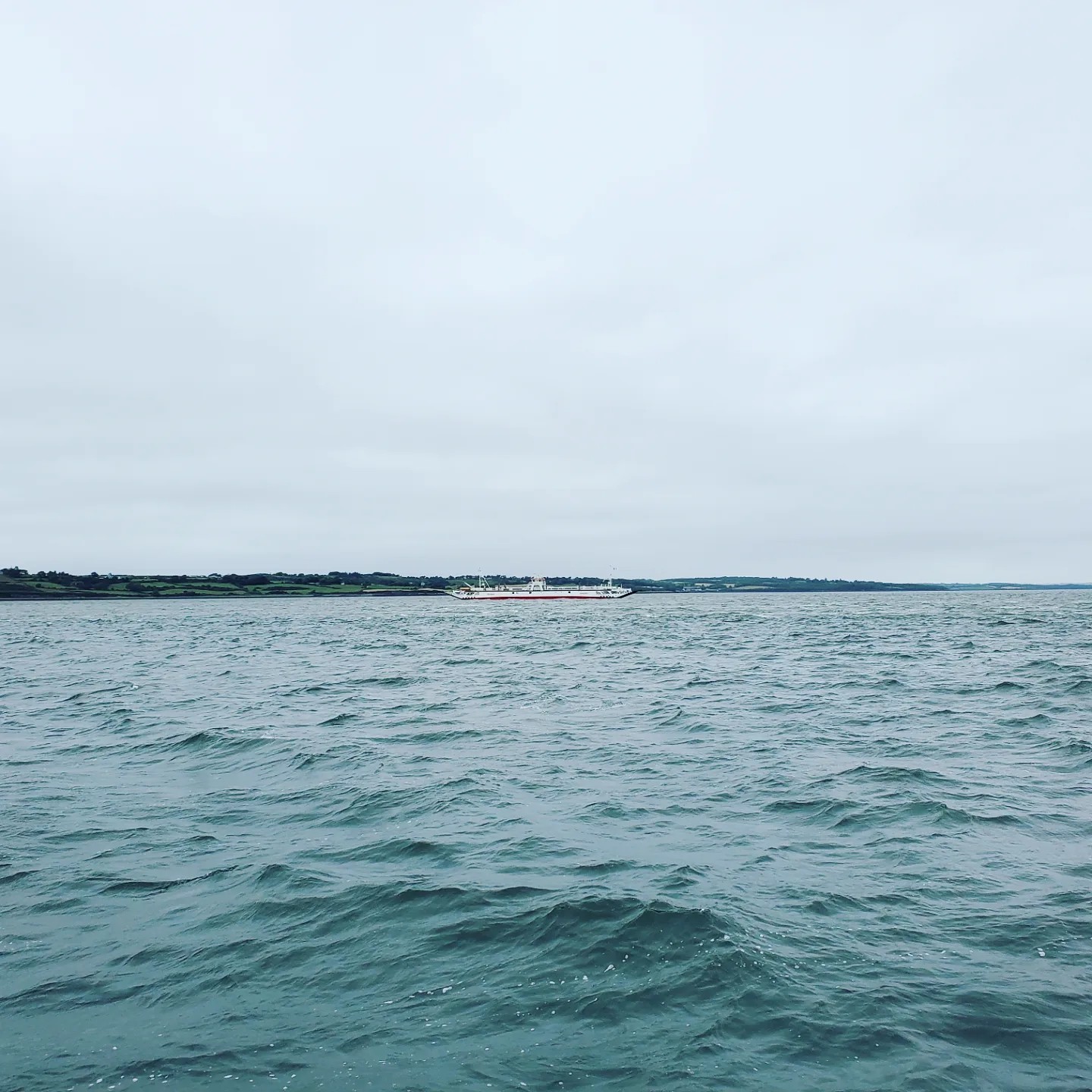
At this point you will be in County Kerry, but I will share a few cool places we saw on the way back to Killarney.
TARBERT
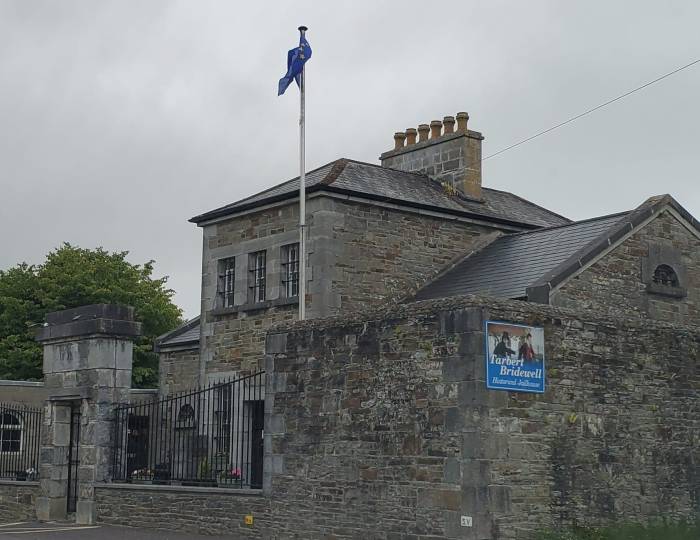
When we arrived in Tarbert, we drove a loop or around town on our way to Blennerville and saw some interesting buildings.
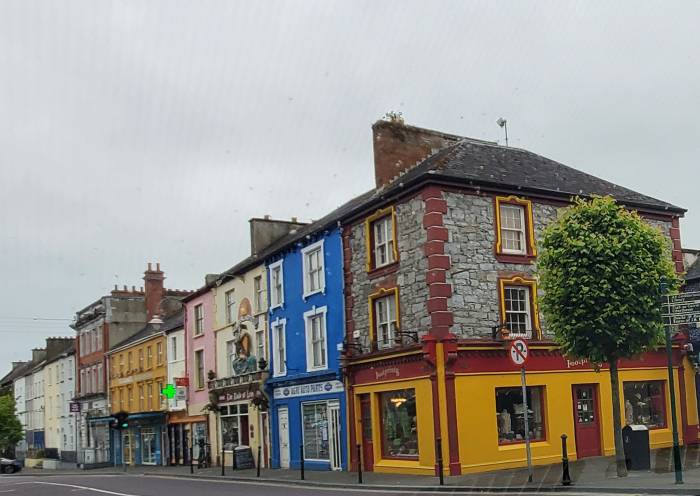
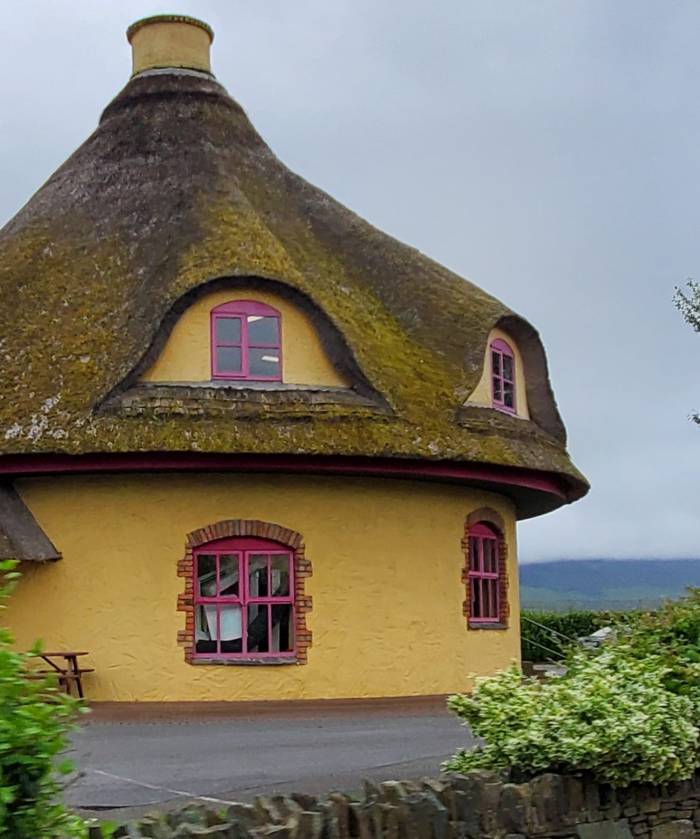
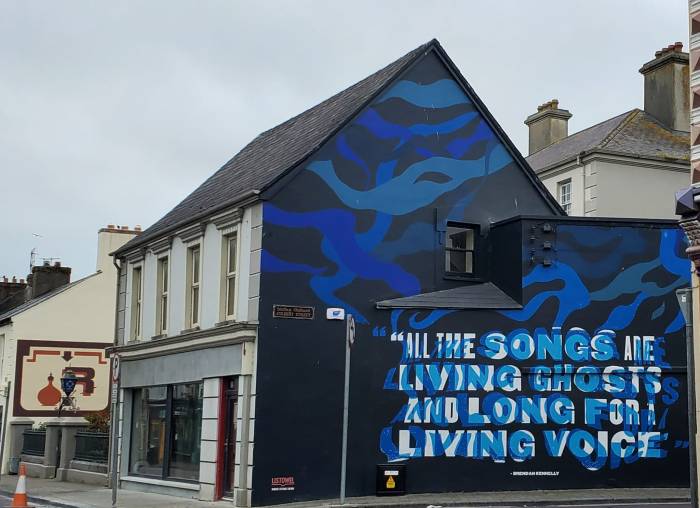
Most curious was the Tarbert Bridewell Courthouse & Jail Museum.
BLENNERVILLE
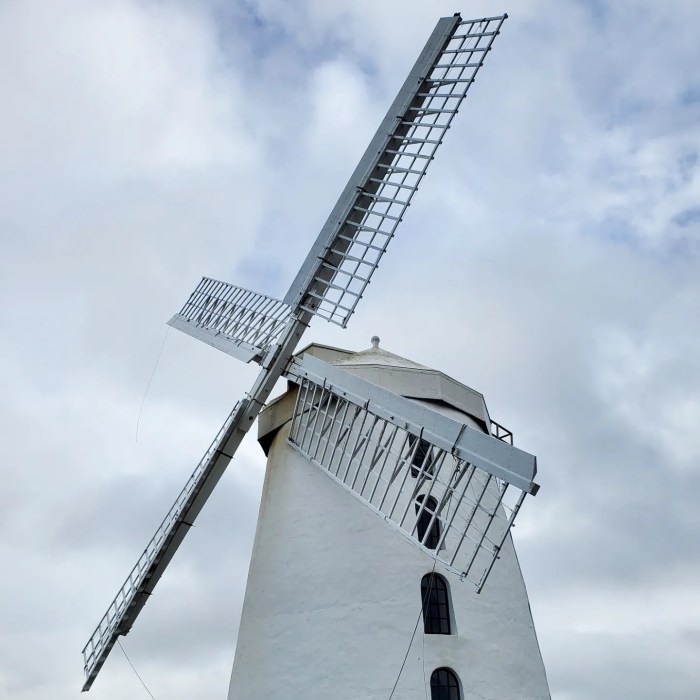
The small community of Blennerville hosts the worlds only commercially operated and tallest windmill, coming in at 70 feet tall. The windmill was built in 1800 by the town’s founder, William Blennerhassett, and it was used for grinding corn until more advanced technologies made it obsolete.
This site is also widely known because it was County Kerry’s point of emigration during the Great Famine between 1845-1852, and home of the famous Jeanie Johnston emigration ship.
From Blennerville, we made our way back to our beloved Lake Hotel in Killarney, right off the Ring of Kerry.
Most of our time in County Clare was spent in the western and southern parts, leaving the northeastern part somewhat unexplored, but I feel like southwestern Clare is where it’s at. Elsewhere, County Clare has the Bunratty Castle, Dromoland Castle, Knappogue Castle, and Lahinch Beach.
In the area for a while? Follow me to the Ring of Kerry, County Galway, and Connemara National Park.
*************
© Fernwehtun, 2015- Current. Unauthorized use and/or duplication of this material without express and written permission from this site’s author and/or owner is strictly prohibited. Excerpts and links may be used, provided that full and clear credit is given to Fernwehtun and Fernwehtun.com with appropriate and specific direction to the original content.



 Fernweh, An Ache for Distant Places
Leave a comment