BLACK HILLS NATIONAL FOREST
The Black Hills National Forest is located in southwestern South Dakota. It spans from Spearfish, Deadwood, Lead, and Sturgis at its northern border down to Rapid City, Hill City, Keystone, Custer, and eventually Hot Springs at its southern border.
You can read my separate blogs about those places by clicking the links, as I complete them.
Here is a popular design of the forest I kept seeing in gift shops, and a link to where I found it online.

At the heart of the Black Hills National Forest sit Mount Rushmore, the Crazy Horse Memorial, Custer State Park, Jewel Cave National Monument, and Wind Cave National Park, with scenic drives and byways heading out in all directions.
It did not take long for me to start thinking that the Black Hills is one of my new favourite regions in the world.
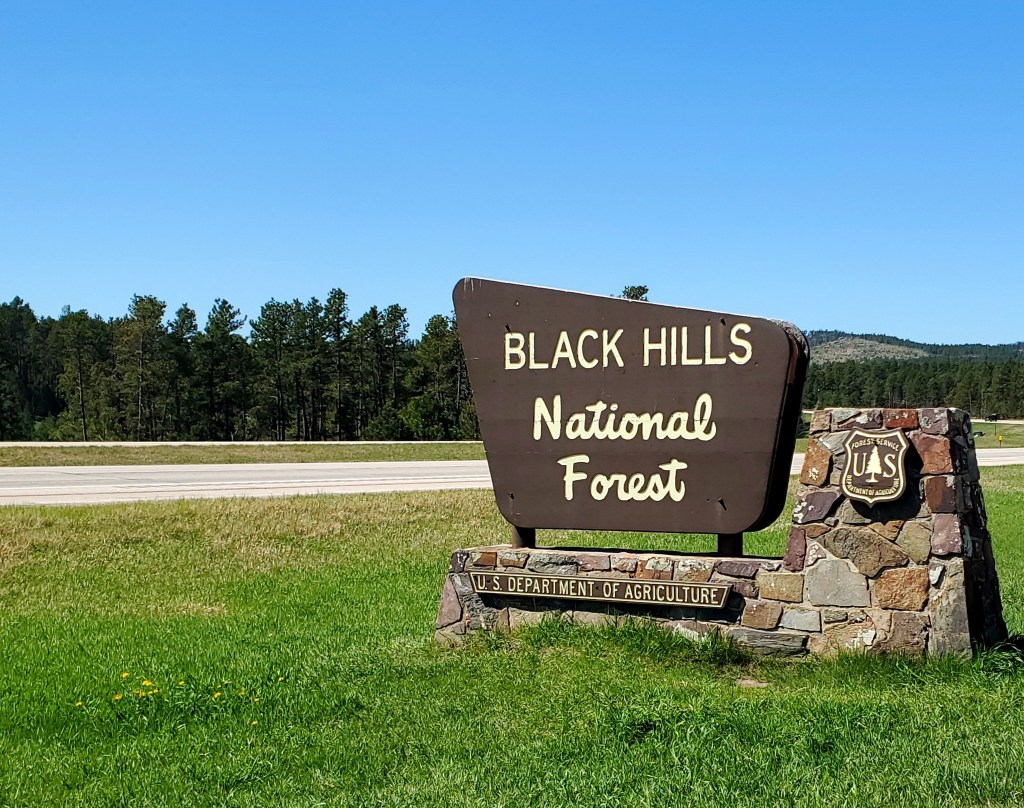
Black Hills became an officially designated National Forest in 1897 by former President Grover Cleveland, and it is allegedly called the Black Hills because the density of its evergreen trees make the forest look black. It suits my aesthetic, for sure.
This land first belonged to the Lakota / Sioux Nation, and it was taken from them through a series of betrayals and broken promises, as per the norm in our country.
Here is an informative Ted-Ed video on Youtube that will fill you in on the dark history of Mount Rushmore:
I also encourage you to check out the incredible NDN Collective, watch their documentaries, learn about the Land Back Movement, and try to understand the struggles they are facing to protect their own land. I visited their HQ in Rapid City recently, but that story is for another blog.

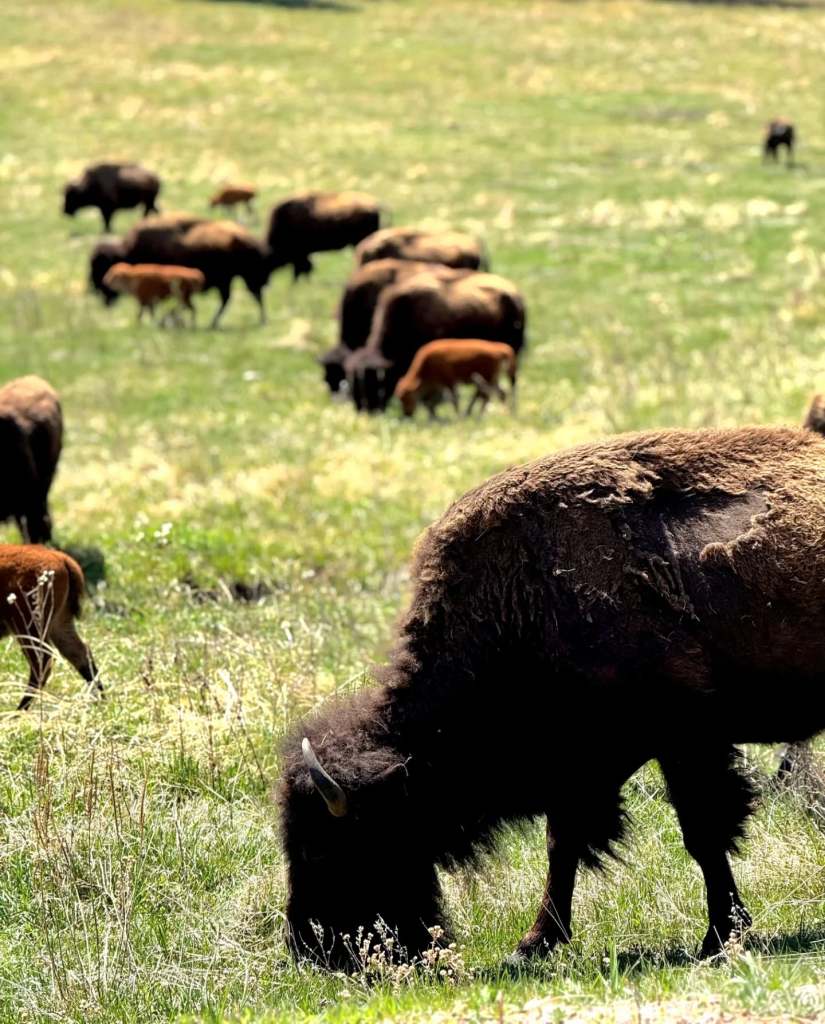
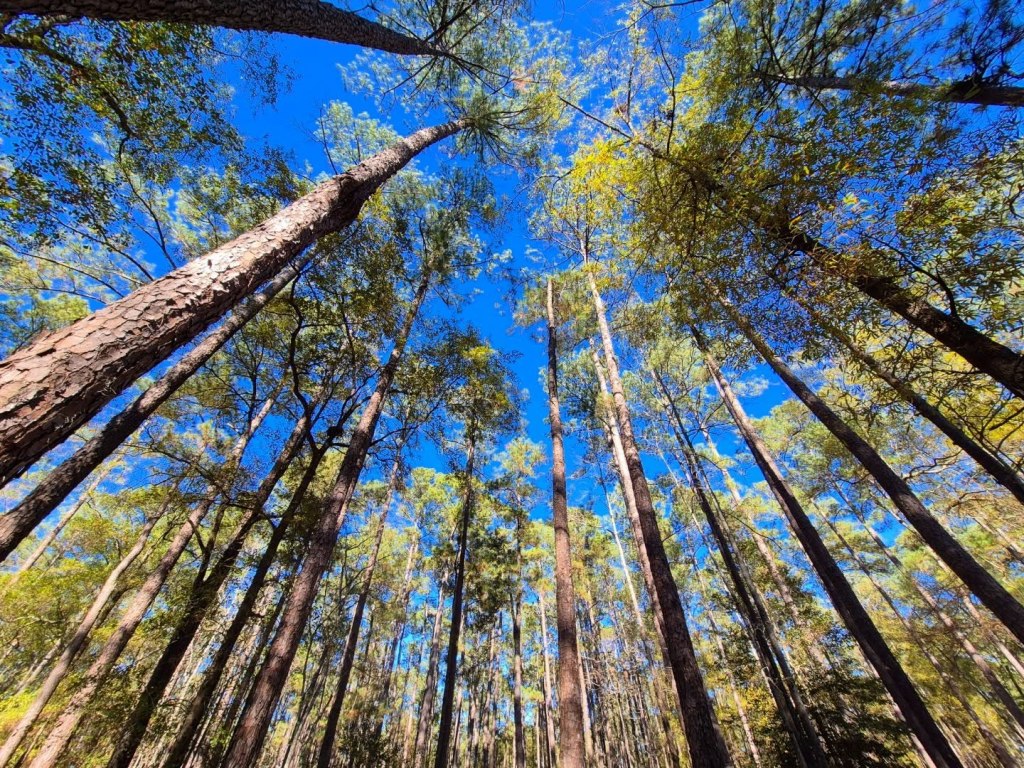
Over 1.2 million acres of Ponderosa pine, birch, aspen, spruce, and cottonwood trees fill the rocky, dry landscape of Black Hills. Buffalo, coyotes, mountain lions, and bobcats are some of its most intimidating residents, but you will see all sorts of birds, prairie dogs, marmots, bighorn sheep, pronghorn antelope, and other critters everywhere you go.
Be on the look out for wild mountain goats, too. They are not native to South Dakota, but their ancestors were once donated to Custer State Park, which shares a border with Wind Cave National Park, by Canadian officials.
The goats escaped their pens a long time ago and are known to roam the hills, cliffs, and roadsides of the Black Hills as they please.
MOUNT RUSHMORE
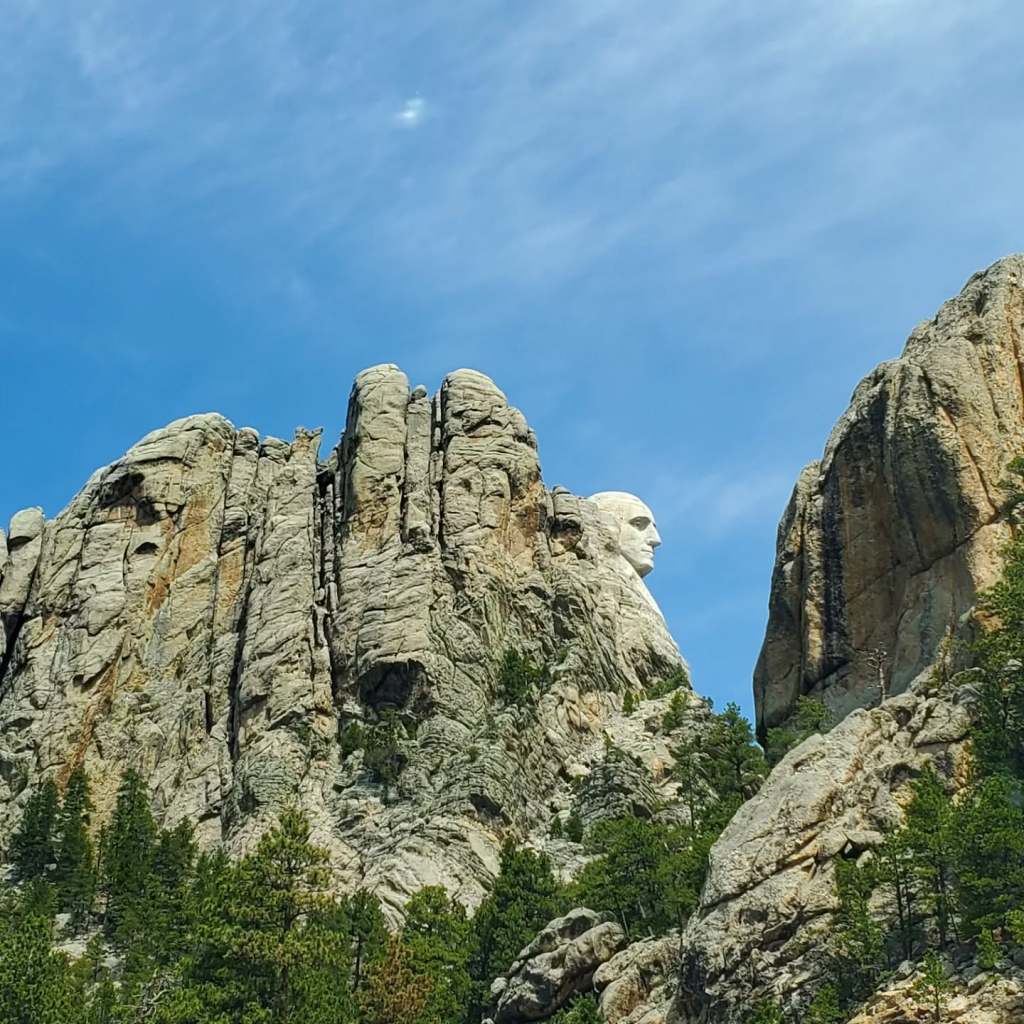
Mount Rushmore is arguably the most popular and internationally known place within the Black Hills National Forest.
It features massive busts of four of the country’s most revered presidents, George Washington, Thomas Jefferson, Theodore Roosevelt, and Abraham Lincoln.

Washington was the first US President and Jefferson was the third, as well as the principle author of the Declaration of Independence, and he served as Secretary of State under Washington.
Roosevelt was the youngest man to become US President, and he is celebrated for championing conservation laws and setting aside millions of acres of public land that became National Parks and Monuments.
Lincoln is most well-known for his Emancipation Proclamation which was a step toward ending legal slavery, and for his assassination in 1865 that was so shocking, it made him impossible to forget throughout time.

Each have their faults but all things considered, not too shabby of choices as far as US Presidents go.
I really liked this poster set I saw around the visitors center.

Gutzon Borglum, the sculptor and project leader of Mount Rushmore, said of these men he selected for the monument:
“Let us place there, carved high, as close to heaven as we can, the words of our leaders, their faces, to show posterity what manner of men they were. Then breathe a prayer that these records will endure until the wind and the rain alone shall wear them away.”

Borglum was born in 1867 to Danish immigrants in Idaho. He started work on Mt. Rushmore in 1927 when he was 60 years old, but he died in 1941 before the monument was officially complete. His son, Lincoln, oversaw the completion of the project.
Borglum was previously known for some controversary around his statue depicting a female Atlas, which reflected his belief that it is actually women who carry most of life’s burdens.
He might have my nod of approval over that, if it were not for his ties to and shared ideology with the K*K. Read more about that here and here and here.
There is a bronze bust of Borglum to your left before you enter the Avenue of Flags. You can learn more about Borglum at the Rushmore Borglum Story museum nearby.

Later features of the monument site like the Avenue of Flags, museum, gift shop, and parking decks were added in the 1990s.

At the end of the Avenue of Flags, you will reach the Grand View Terrace with the best view of the monument.
Look down for a view of the amphitheater below.

Enter the visitors center to the left of the terrace to view some pretty awesome exhibits about the history of the monument’s creation and the people who worked on it.

Follow the Presidential Trail which starts and ends at either side of the terrace. The trail is 0.26 miles and includes 422 steps.
If you begin to the right of the terrace you will soon reach the Sculptor’s Studio which is open seasonally, and as you make your way toward the back center of the trail, you will be positioned toward the Youth Exploration Area and the Lakota, Nakota, and Dakota Heritage Village.
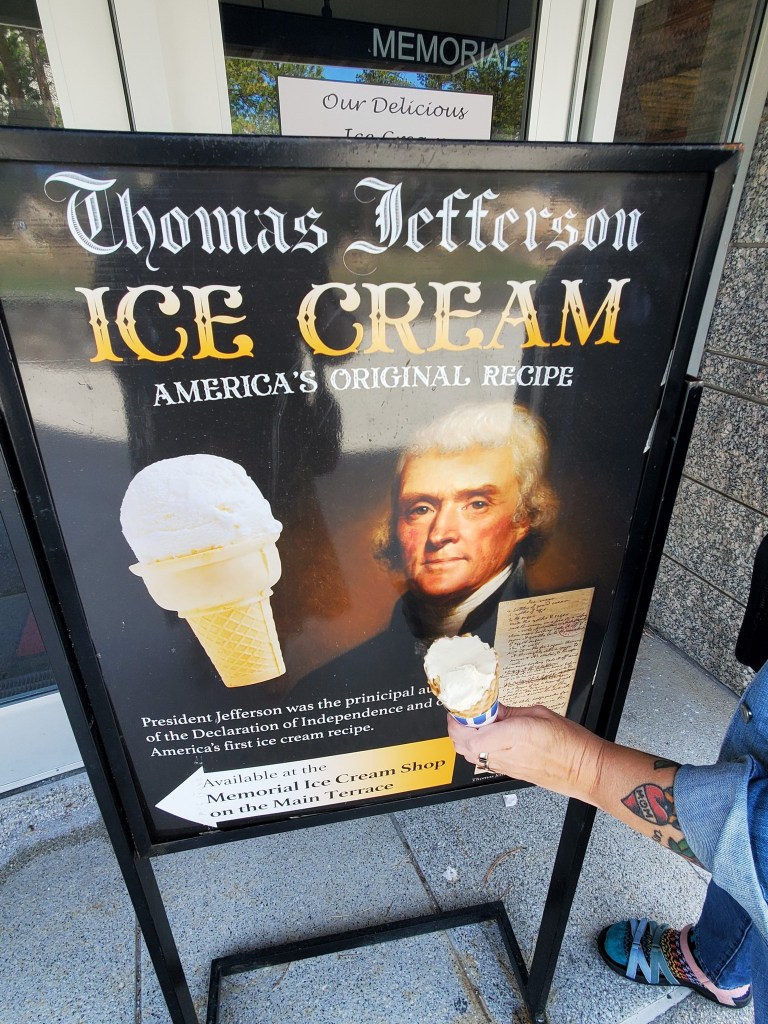
The ice cream shop at Mount Rushmore scoops out a vanilla cream recipe invented by Thomas Jefferson himself, if you get a hankerin’.
Something I personally enjoyed was the Stone Hoop Ethnobotany Garden, just outside the parking deck. It features various astrological and celestial alignments that are significant to tribal culture, as well as pan-cultural equinoxes and solstices.
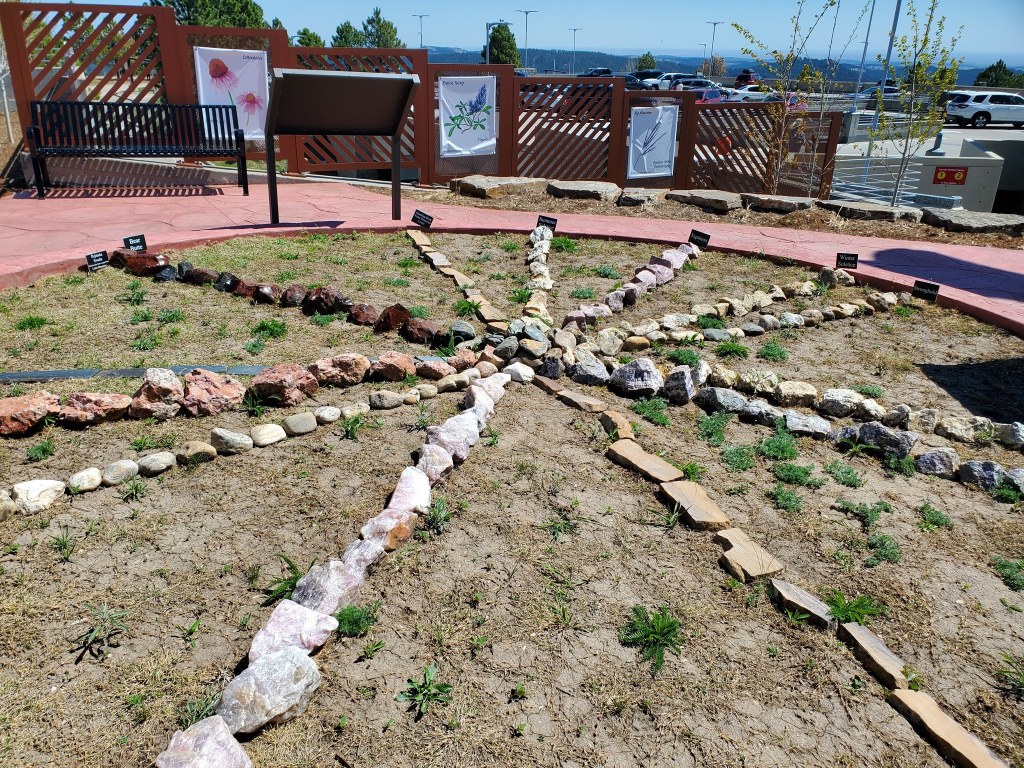
The garden was created through a collaboration of the 21 Associated Tribal Nations surrounding the land that Mount Rushmore is on. Informative plaques and signs explain different days and cycles, and each of the medicinal herbs on display are also written in local Native American language(s).

Mount Rushmore hosts an Evening Lighting Ceremony in its amphitheater each night during the summer. The monument is illuminated by automatic lights for a brief period after sunset during the rest of the year.
You can view the monument while driving along the main road, but I would definitely encourage you to make time to stop and tour the whole site.
Entry to Mount Rushmore is free, parking is $10, and you can either pay at a kiosk in the parking deck or inside the cafeteria or gift shops when you present your ticket.
KEYSTONE
Mount Rushmore is located in the city of Keystone, South Dakota, in an unincorporated community called Pennington County.
Tourist sites call Keystone the “Playground of the Black Hills” and the title is well-earned with dozens of attractions in such a small area. The 2020 census lists less than 250 residents in the town.

Like the rest of the towns in Black Hills, Keystone took off as a mining town and was expanded by the railroad industry. Read more about Keystone’s specific mines and history here.
While Keystone is most famous for Mount Rushmore, it is also where Little House on the Prairie author Laura Ingalls Wilder and various members of her family spent time throughout their lives.
Keystone Historical Museum showcases the Carrie Ingalls Collection and is located in the former town schoolhouse that was built in 1899. For the entire month of May, it becomes the “Living History School” where local students attend lectures on late 1890s/early 1900s topics in period style clothing.
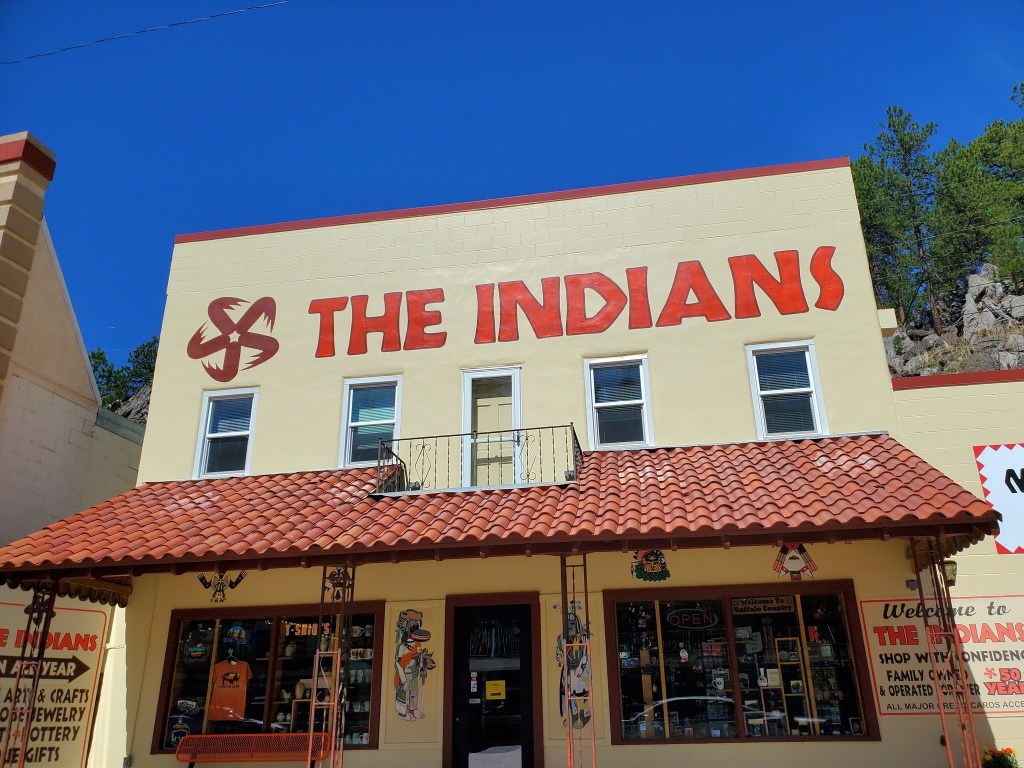
The Indians shop is also packed full of local culture and wares.
The Keystone Historic Walking Tour map is also available as a printed brochure at many local business, and will lead you to nearly two dozen significant sites like Big Thunder Gold Mine which was founded by two German immigrants in 1892, the Holy Terror Mine which was the richest gold mine in the southern Black Hills, the town’s historic church, school, icehouse, blacksmith shop, doctors office, boarding home, motels, mercantiles, and saloons.
The Rushmore Borglum Story is a museum dedicated to Gutzon Borglum, the sculptor of Mount Rushmore who I mentioned earlier.
The museum features a self-guided audio tour through the “World’s largest Borglum Art Exhibition.” You can also view more of Borglum’s famous works here.

The Rushmore Borglum Story is located behind the Dahl’s Chainsaw Art location in Keystone, which features the largest carved Bigfoot sculpture in the country. You can find Dahl’s locations all over the Black Hills and beyond.

1880 TRAIN
The 1880 Train steam engine is the oldest continuously-operating standard gauge excursion train in the world. Passengers can embark on daily 20-mile round trips between Keystone and Hill City, altogether lasting around two hours.

It is possible to purchase a one-way ticket during certain times but then you would be on your own getting back to where you started from either depot.

The tour is guided by real, live humans who tell you about the train’s backstory, its steam engine, and required care.

If you are lucky, you will get to see some of that care and maintenance go down in person.
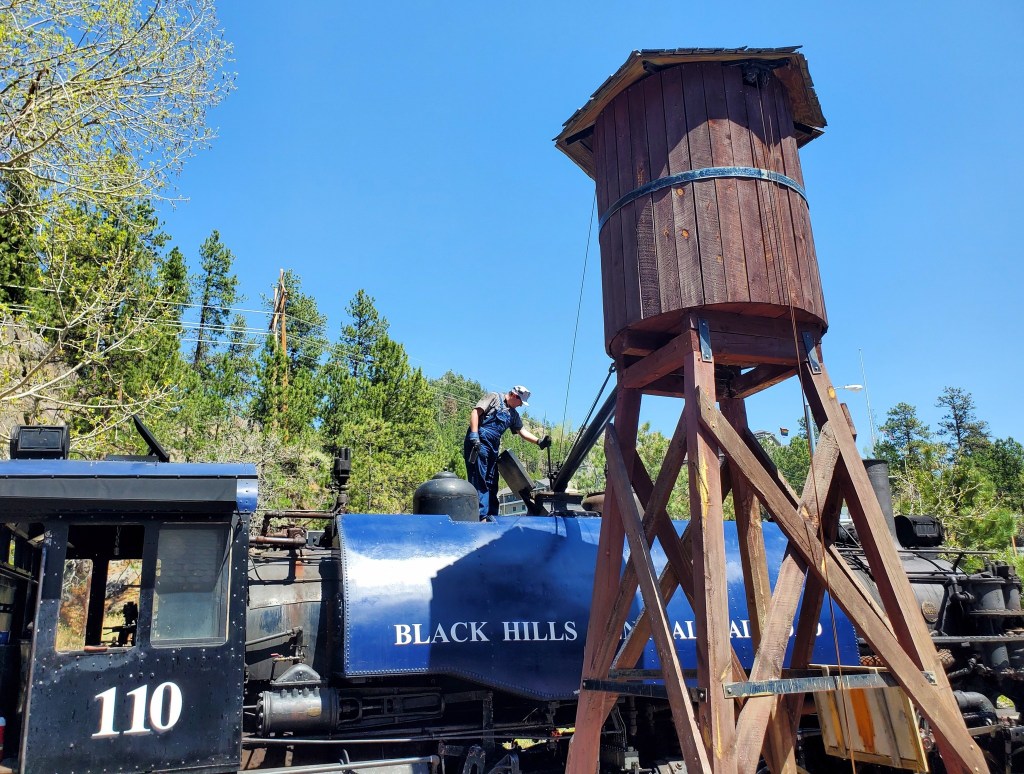
Guides will also tell you about various sites you pass along the way like the Holy Terror Mine, Good Luck Tungsten Mine, Keystone Junction, Old Baldy Mountain and Elkhorn Mountain, Black Elk Peak, and Kennedy House.

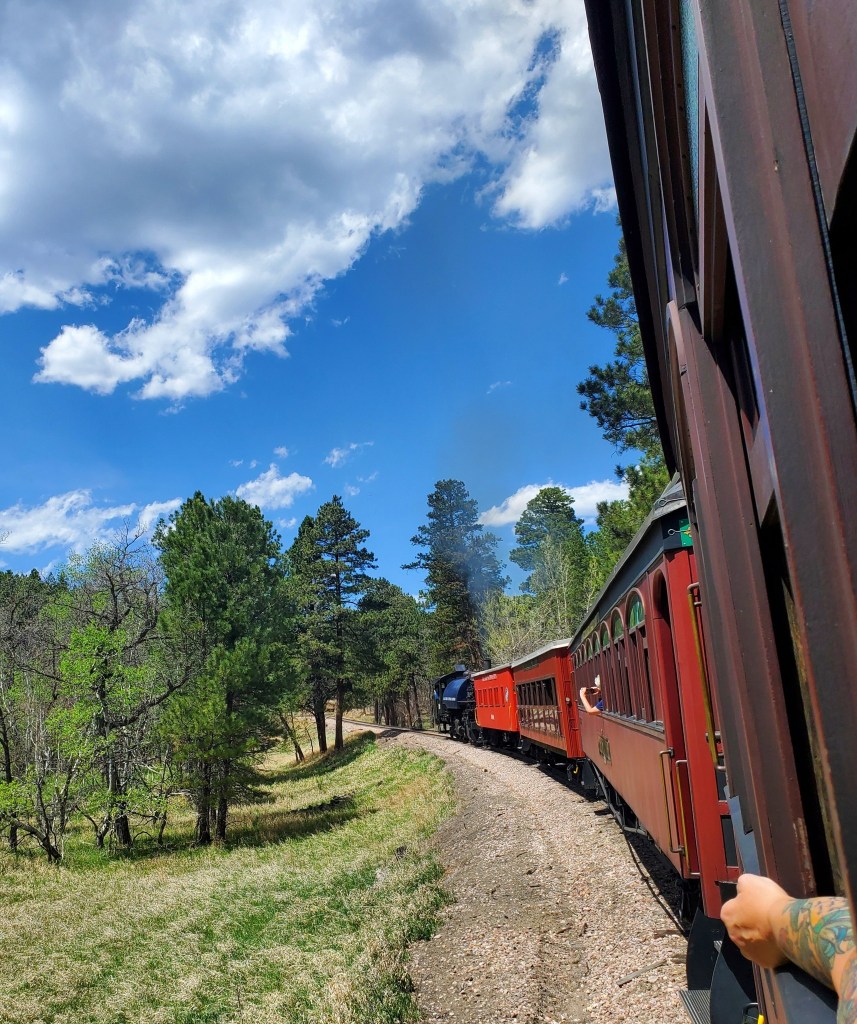
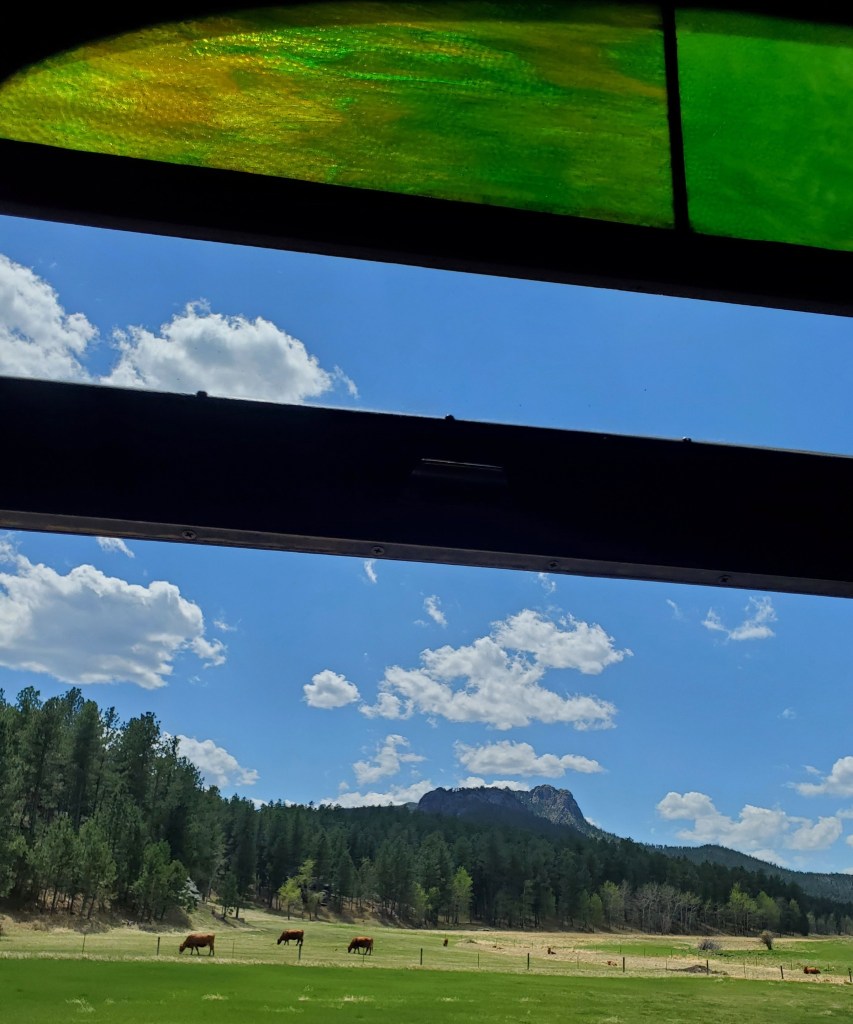
We enjoyed seeing lots of wildlife, cattle, and horses along along the way.
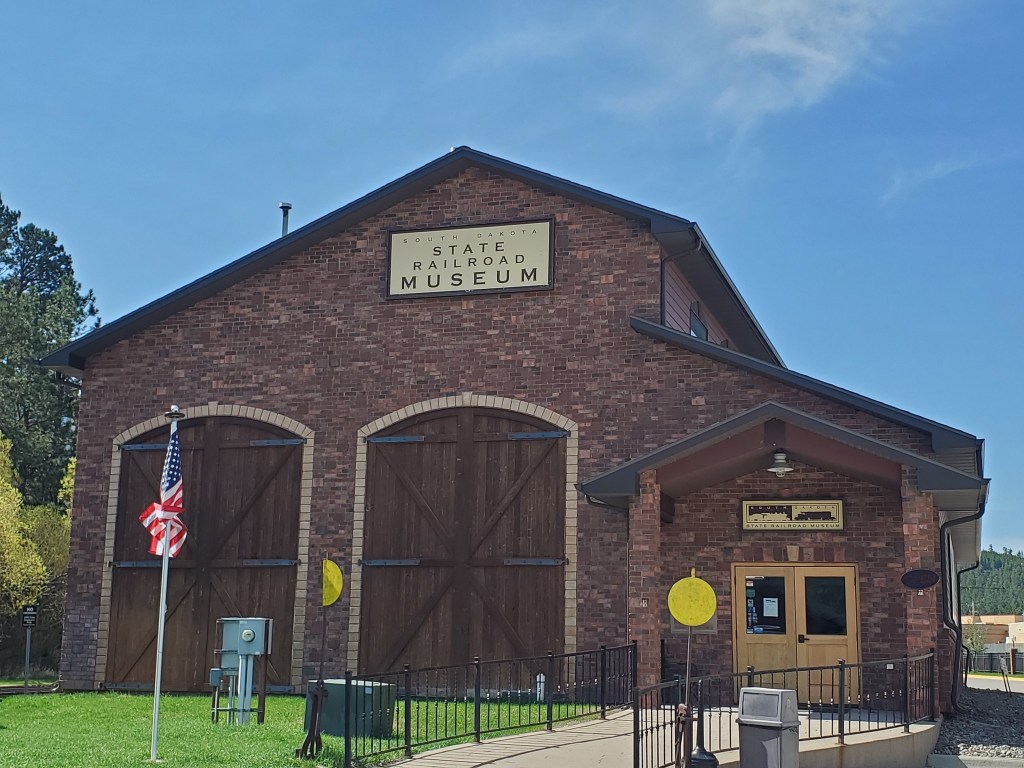
Boarding in Hill City, you can visit the High Liner Eatery and the State Railroad Museum before or after the journey.

CRAZY HORSE MEMORIAL
While it is currently unfinished and many more years are projected until completion, the Crazy Horse Memorial is already the largest mountain carving in the world.

The memorial is located in the town of Crazy Horse in the Black Hills.

Crazy Horse was born in 1840 as Čháŋ Óhaŋ (“Among the Trees”), and in childhood his nickname was “Curly” because of his unique, curly, light-brown hair.
His grandfather was the first Crazy Horse, but he passed it down to his son and then his grandson, who we all know as THE Crazy Horse. Technically he is Crazy Horse III, but names are not permanent and often change throughout the lives of tribal members to reflect their individual characteristics and achievements.
Crazy Horse was a member of the Oglala band of Lakota people living in the Black Hills. He was revered as a hero for his war prowess and for winning the Battle of Little Bighorn.
Here is a great video on Youtube to learn more about Crazy Horse:
At the Crazy Horse Memorial, admission also includes entry to the onsite Indian Museum of North America and the Indian University of North America.

Both organizations offer various cultural and educational events throughout the year.

The entire complex is overflowing with information, artifacts, and exhibits on every aspect of Native American culture and history, from spiritual beliefs to significant battles, and a showcase of individual members’ art.
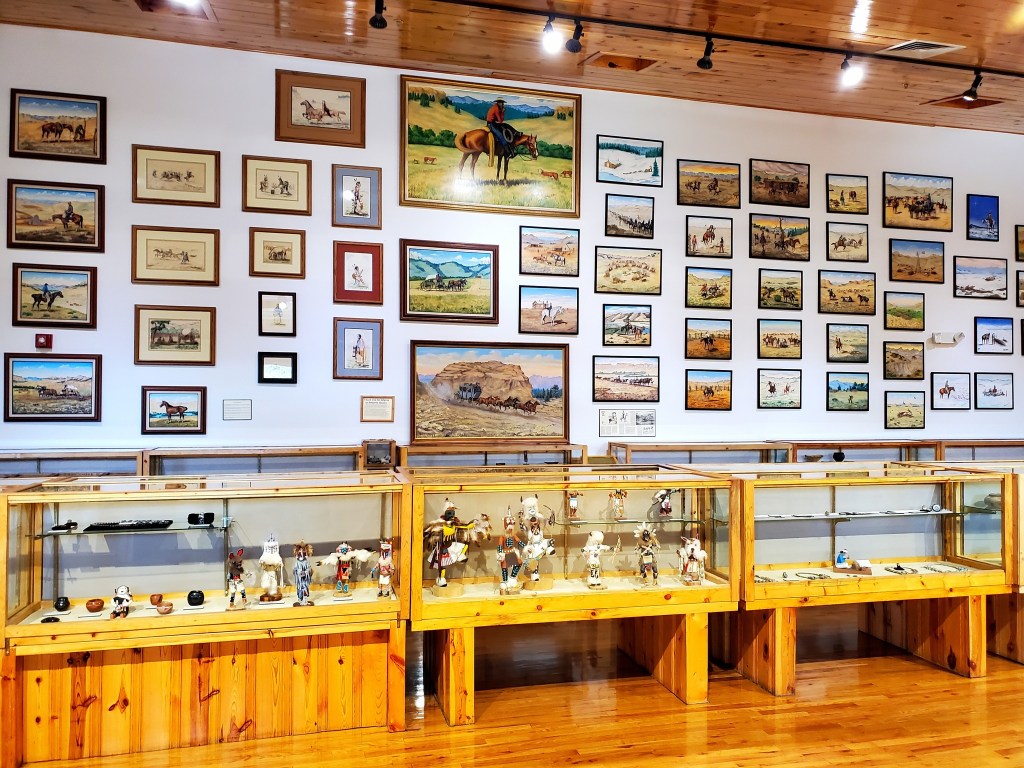
I especially loved all the handmade pottery and sculptures.


There is an impressive collection of bronze sculptures inside the exhibits, courtyards and parking lots, an entire downstairs room, and a beautiful gate that depicts nearly 300 different animals.


This model shows what the memorial will look like upon completion, compared to the current site in the background:

Visitors can pay $5 extra for a guided bus tour that goes up to the monument with plenty of time to take photos before returning. The guide will also direct you to a vault where you can pick out your own free souvenir rock from the carving site. This was very exciting for us Rock Pickers.

OTHER PLACES TO GO
Due to time and availability constraints, we were not able to visit the Jewel Cave National Monument or to spend much time around Bear Butte State Park, a sacred Lakota site, but both are top items on our list for next time in the Black Hills National Forest.
There are countless other attractions like mini golf and gold panning and kitschy tourist experiences but we always prioritize natural wonders and historical sites when we travel. If you are more inclined to those activities, you are going to be overwhelmed with abundant options there.
In the area for a while? Stay tuned for upcoming blogs about other fascinating places in the Black Hills like Custer State Park, Wind Cave National Park, Spearfish Canyon, Deadwood, Lead, Rapid City, Hot Springs, Wall Drug, and the Badlands National Park.
*************
© Fernwehtun, 2015- Current. Unauthorized use and/or duplication of this material without express and written permission from this site’s author and/or owner is strictly prohibited. Excerpts and links may be used, provided that full and clear credit is given to Fernwehtun and Fernwehtun.com with appropriate and specific direction to the original content.

 Fernweh, An Ache for Distant Places
Leave a comment