
WIND CAVE NATIONAL PARK
Wind Cave National Park was signed into park status in 1903 by former President Teddy Roosevelt, making it the seventh oldest National Park in the US and the first to be dedicated to a cave.
It is located on a little over 28,000 acres in southwestern South Dakota’s Black Hills National Forest region.
Wind Cave was named after the significant amount of air the blows in and out of the cave’s small natural entrance and it is cited for being one of the best known examples of a “breathing cave.”
Basil Brave Heart, an Oglala Lakota man, describes it as “the wind coming out of Wind Cave is pure spirit…sacred vibration, life is a sacred vibration, the world vibrates with breath.”

This massive underground cave is the third longest cave in the US and sixth longest cave in the world, with nearly 170 miles of explored and document passages as of 2025.
Wind Cave is also one of the most complex and densest cave systems in the world and after a century and a half of exploration, no one has found the real end of it yet.

Wind Cave has many large interior chambers with names like the Elks Room, the Post Office, and Eight Room, its largest which is about the size of a football field.

Its deepest and lowest point is Windy City Lake that lies more than 500 feet below the surface.

UNIQUE CAVE FORMATIONS
Paha Sapa is the Lakota word for Black Hills, and Paha Sapa limestone describes the very specific limestone found in this area and that comprises the structure of Wind Cave itself.
Paha Sapa limestone is made of three layers; thick calcite fissures, boxwork and protrusions in the middle, and white limestone on its newest top layer.

More than 90% of the world’s known Boxwork formations are found inside Wind Cave.

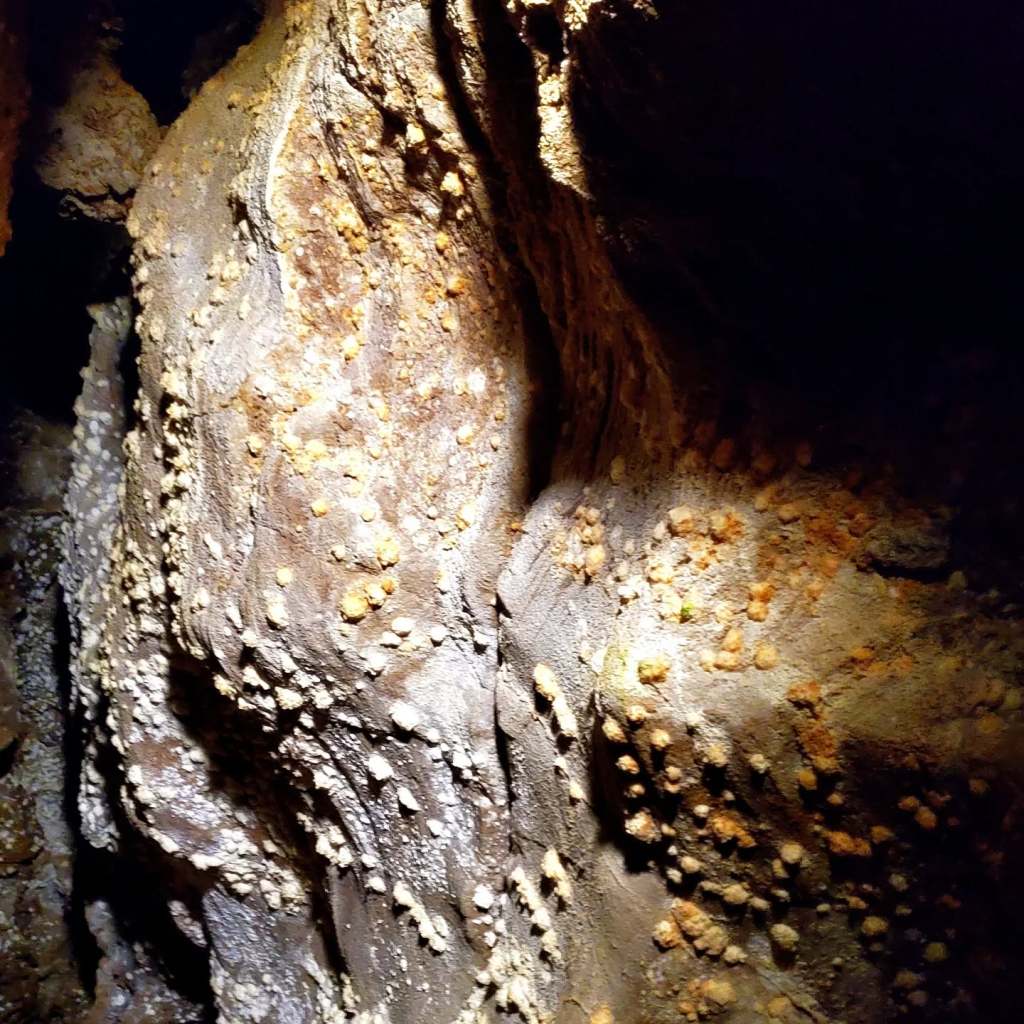
These delicate and irreplaceable calcite formations have a honeycomb appearance and will not regenerate once damaged, so please honour the park’s no-touching policy.

Cave Popcorn and Dogtooth Spar formations are also found easily in Wind Cave.

WILDLIFE & TRAILS
Outside the cave, Wind Cave National Park is a diverse ecosystem of its own and is home to all sorts of animals from badgers, prairie dogs, ermines, black-footed ferrets, pronghorn, skunks, raccoons, and whooping cranes, to elk and bison, and to more predatory animals like red foxes, coyotes, bobcats, and cougars.
The bison herd at Wind Cave is one of just four remaining “genetically pure” herds left to freely roam public lands in North America. Others are found in Yellowstone National Park, in Utah’s Henry Mountains, and Canada’s Elk Island, and you can learn more here about why that is important.

There are a few different trails and over 30 miles of trails in the park, specifically the most popular Rankin Ridge Trail.
SD Hwy-87 and US Hwy-385 are the main roads through the western side of the park with the densest trails and landmarks.
If you are interested in Geology, follow the Wind Cave Geology Driving Tour.
The eastern side of the park can be traversed by the gravelly NPS 5 and NPS 6 roads where it is more back country and remote, but you will have the most likely chances of being able to sit and observe bison herd activity and other animals.
We had multiple, stunning encounters within our first half hour that morning.
TOURS
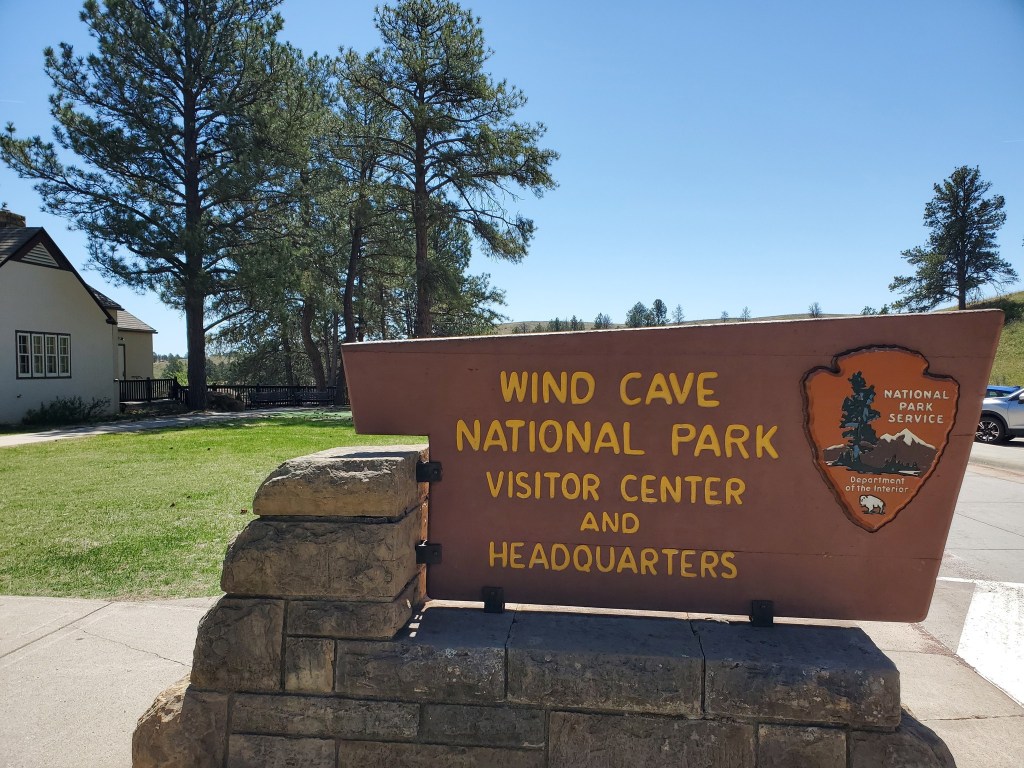
It is free to enter Wind Cave National Park, but you can only enter the cave itself legally if you purchase tickets for a guided tour. All tours start at the Visitors Center where you can purchase same-day tickets.
Visitors can choose from a roster of cave tours based on length, strenuous levels, themes, and seasonal availability.
In early May, I definitely recommend the Natural Entrance Tour and the Garden of Eden Tour.

UH, WE GOT A PROBLEM
We had two problems visiting the park. The first problem is that I tried for three days to book our cave tour in advance and was led on a proverbial wild goose chase of linkbacks, reroutes to other sites, broken links, and unavailable pages.
We decided to just show up and hope they still had tours available, and thankfully that worked for us that time, but that may not work out for you on busier days.
The ranger in the visitors center quipped to me that I should have bought tickets in advance, and when I explained all the trouble I had experienced, he said “well, the site has been down.” Cool. That tracks.
He also said the website does not sell same day tickets for tours, you just have to show up in person. None of that was stated on the website so that I could have POSSIBLY known.
Our second problem was that the website said to NOT use GPS to get there. That’s it, no other helpful info. If you have never been there and do not know your way around the state of South Dakota yet (like us!), you will probably rely on GPS like any other person. But like, don’t.
We did, and we ended up entering the park through some underdeveloped private property, Red Valley Road, and then NPS 5, essentially making our way backwards through the park and to the visitor center.
I have just learned that the park page has updated coordinates to the visitor center, lucky you, or you could also just do it backwards like we did. It was fun.

THE BACKSTORY
Wind Cave was featured in a book called And the Wind Whispered by author Dan Jorgensen. I have not read it yet, but if you have, give me the scoop.
Wind Cave’s real backstory is full of sacred lore, land battles, broken promises, being the site of the Sanson family homestead, and hosting a CCC camp back in the 1930s. Click here to read more in-depth history of Wind Cave and Wind Cave National Park, but here is what I found most interesting.
In the early 1880s, South Dakota Mining Company commissioned a man named Jesse D. McDonald to oversee the new site of their mining claims, but no gold or valuable mineral deposits were found. McDonald’s family was left to start developing the land and its cave as a tourist attraction.

His teenaged son, Alvin, took a pointed interest and began independent explorations in 189. Alvin spent the rest of his life leading tours and keeping records of his advanced discoveries. The maps he drew and the information he gathered are what today’s tours are based on.
During McDonald’s life, another family called Stabler initiated a feud over the land which lasted many years. Finally in 1900 the Department of the Interior ruled against both families, citing that neither could claim title to the site because it had neither been developed for homesteading or mining.
That is how it ended up being available for grabs in 1900 and made into a National Park.

MORE LAND BATTLES
The battle over the Black Hills, where Wind Cave National Park is located, is generally considered the longest land battle in the history of this country and it has been ongoing for over a century. Smithsonian describes this as a landmark case “that brings into question the very meaning of international agreements and who has the right to adjudicate them when they break down.”
This land first belonged to the Lakota Sioux People, and that is where most of them still live. They do not have much of a choice.
The Fort Laramie Treaties of 1851 (The Horse Creek Treaty) and 1868 (The Sioux Treaty) are when the US Government officially acknowledged the sacred significance of the Lakota Sioux homelands and titled the land to them, like it was theirs to decide.
A decade later when some white guys claimed to find gold in them thar hills, the USG reversed its promise, seized the land, and started dispensing out allotments to white settlers.
The USG offered cash settlements to the Lakota, but they wanted their LAND BACK, and so the USG’s solution was to create ghettos we politely call “Reservations” to confine them.
I really love the design of this overview by Smithsonian’s National Museum of the American Indians about the treaties and wars that have unfolded during this land battle.
Red Cloud’s War is the most famous and well-known battles during this time. Check out this Youtube video:
That bastard former President Andrew Jackson’s 1830 Indian Removal Act and his cousin Abraham Lincoln’s 1862 Homestead Act, and former President Grover Cleveland’s 1887 Dawes Act, and OMG so much other horrible legislation that has passed in this country all allowed even more white settlers to seize land belonging to Native Americans and murder them. Perhaps you have heard of the Trail of Tears.
To this day, the Homestead Act is the largest federal mass execution in US History, courtesy of Abe Lincoln. Is anyone still wondering why Native Americans hate seeing his face carved into their precious and sacred mountains at Mount Rushmore?
In 1980 the US Supreme Court once again acknowledged their crimes and offered the Sioux Nation a cash settlement which they declined, responding that they only want their #landback and for the US Government to finally keep the promises it made over and over to them. Nothing more.
You can read more about that here, here, here, here, here, here, here, here, and here… and I will stop myself there.
Obviously a lot of huge government and world-leading organizations are admitting that all of that really happened and it was wrong and it is still ongoing, but the Lakota people still have not received justice.
Here is a video from NDN Collective interviewing the badass matriarch of Land Back activism, Madonna Thunder Hawk, self described as the “Forest Gump of Indigenous Resistance because she has literally been at almost every focal point of Indigenous resistance for the past 55 years.”
SIOUX, LAKOTA, & OGLALA- WHO ARE THESE PEOPLE?
Many of the people who live in the South Dakota Black Hills are Lakota, specifically Oglala Lakota, which is part of the Great Sioux Nation. Most Lakota do not call themselves Sioux, however.
The Oglala Lakota are one of seven subtribes or bands of the Lakota and calling oneself “Oglala Lakota” is a way to indicate their specific cultural, geographical, and historical identities.
Oglala is a Lakota phrase that means “to scatter one’s own” and it is the name for the people living there just as much as it for places like Oglala County, the Oglala community within that county, the Oglala Lakota Living History Village, and Oglala Lakota College.
As a sidenote, you can visit nearby sites like Black Elk Peak, Bear Butte State Park, Devil’s Tower National Monument, and Buffalo Gap, the Wounded Knee Memorial and Museum, Akta Lakota Museum in Chamberlain, SD to learn more about them.
Most Oglala Lakota people live on the Pine Ridge Reservation, but that is a devastating story I will share in my Badlands blog.

LAKOTA EMERGENCE
The whole of the Black Hills are full of sites that are sacred to the Lakota, especially Wind Cave, which is the setting of the Lakota Emergence Story and how they believe humans entered the world.
I do not believe anyone could tell the Lakota Emergence Story better than actual Lakota people, so here are two versions in their own words.
The first video I am sharing is from a Lakota ranger and guide at Wind Cave National Park, and the second video is by an elder Lakota storyteller named Duane Hollow Horn Bear.
FAMOUS OGLALA LAKOTA LEADERS
Some of the most famous Oglala Lakota leaders include Red Cloud (1882-1909), who I shared a documentary about several paragraphs back.
He is most well-known for winning the battle to close off the Bozeman Trail, protecting sacred buffalo grounds, and establishing a Jesuit-ran school for Native American children.
Crazy Horse (1840-1977) is most well-known for fighting to preserve the traditions and way of life of the Lakota people and leading the Battle of Little Bighorn in 1876 along with Chief Sitting Bull who was from another Lakota tribe.
Black Elk (1863-1950) was a medicine man and holy man of the Lakota people, as well as Crazy Horse’s cousin.
He fought in the Battle of Little Bighorn with Crazy Horse and Sitting Bull, survived the Wounded Knee Massacre in 1890, became part of Buffalo Bill’s Wild West traveling show and was famously interviewed as the subject of the 1932 Black Elk Speaks, a book I can literally see right now on my own bookshelf.
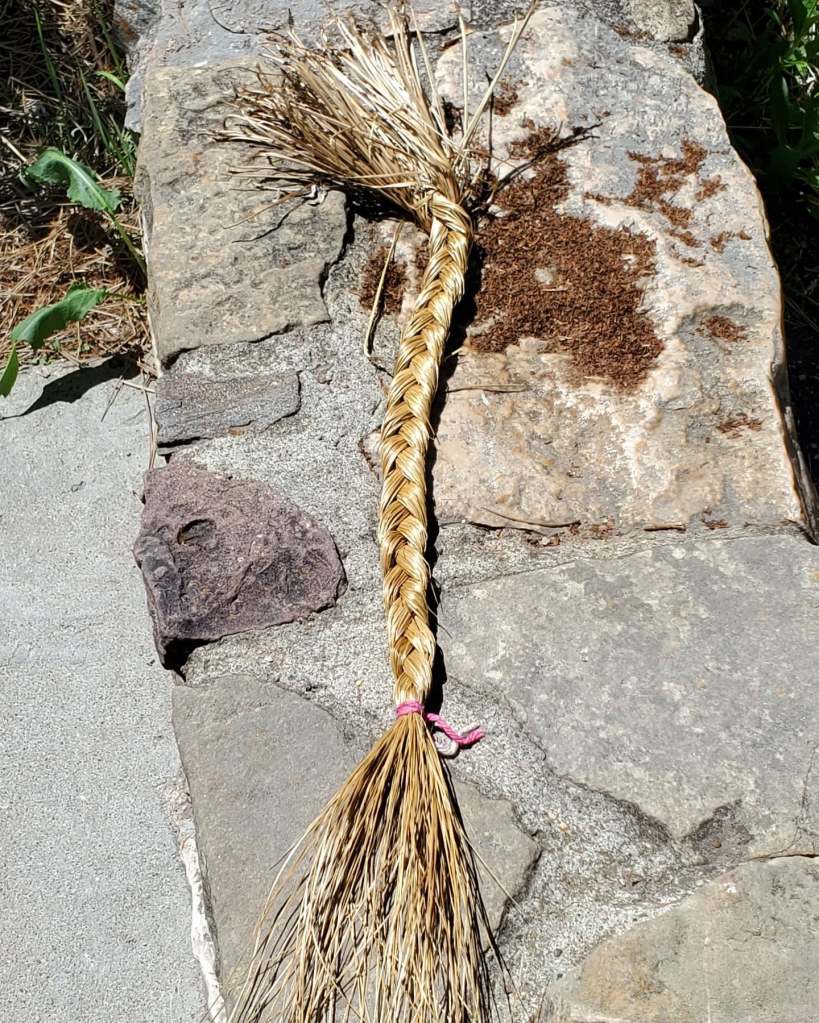
Many Lakota people frequently visit Wind Cave as a spiritual site and it is very common to see symbolic items like braided sweetgrass and prayer cloths tied into trees.
Be a good human and avoid touching or moving things.

THE MEDICINE WHEEL
Make time to view the Indigenous Medicine Wheel exhibit and other exhibits in the Visitor Center while you are there.
I have been vaguely familiar with the Indigenous Medicine Wheel for most of my adult life, but I continue to learn more about it. This exhibit is what made me actually slow down and read more into it.
Each of the four components of the Medicine Wheel are also linked with a direction, a life phase (infancy, youth, adulthood, and elderhood), as well as a colour and an animal guide.
For example, the colour black is for Hoksicala which relates to North, and the Infancy stage of our lives. We are protected by thunder beings during this time. Red, Yellow, and White all have their own individual characteristics.

Here is one more short video about the Medicine Wheel, which varies between different tribes, if you are interested in learning more specifics:
In the area for a while? Follow me to other rad sites in the Black Hills region like Keystone, Mount Rushmore, Crazy Horse Memorial, Badlands National Park, Spearfish Canyon, Deadwood, Lead, Rapid City, Hot Springs, and Wall Drug.

*************
© Fernwehtun, 2015- Current. Unauthorized use and/or duplication of this material without express and written permission from this site’s author and/or owner is strictly prohibited. Excerpts and links may be used, provided that full and clear credit is given to Fernwehtun and Fernwehtun.com with appropriate and specific direction to the original content.

 Fernweh, An Ache for Distant Places
Leave a comment