
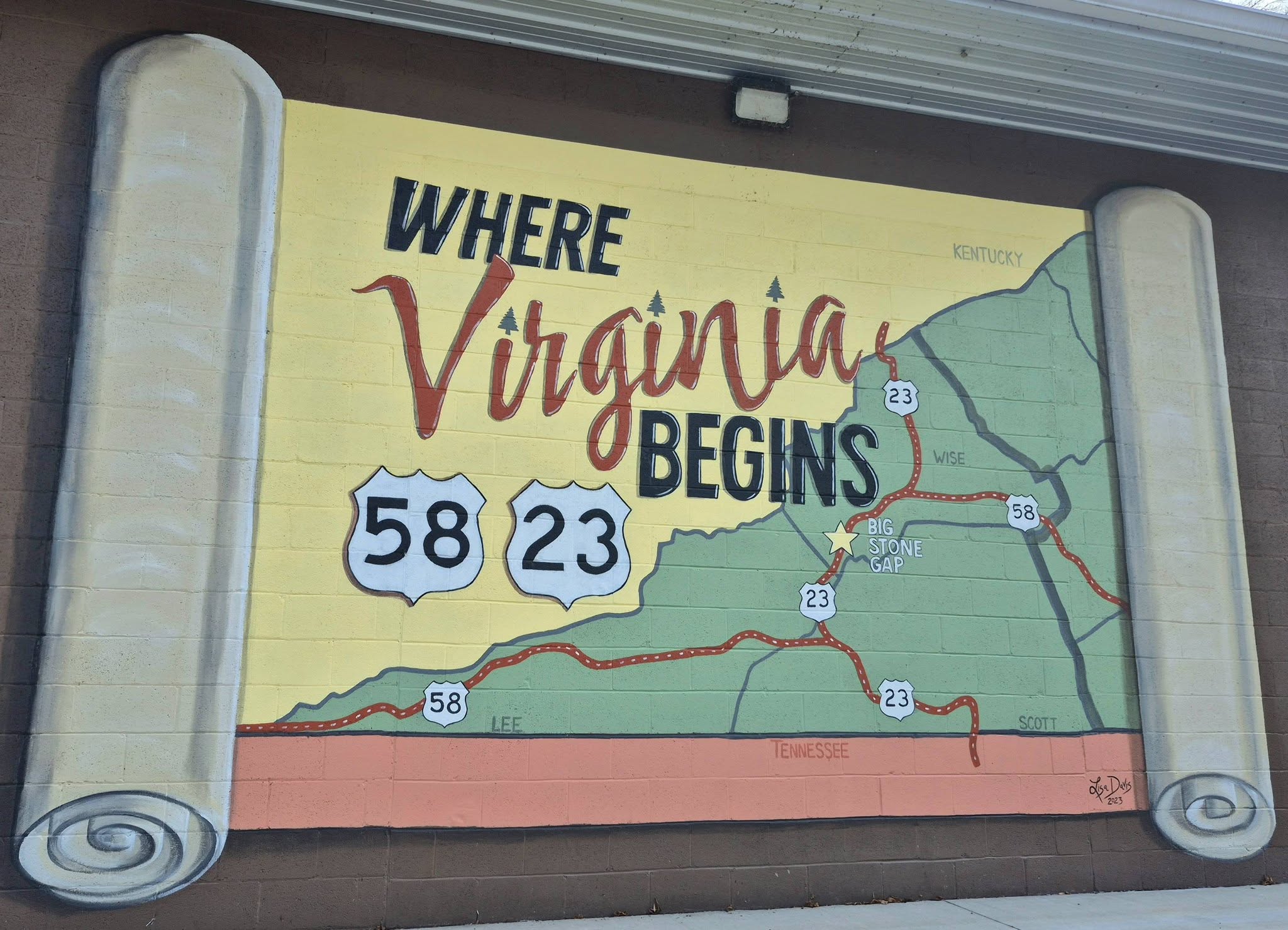
WISE COUNTY is located at the most western end of southwestern Virginia, squeezed right in between the Kentucky and Tennessee state borders. It was established in 1856 and named for Virginia’s then-Governor, Henry A. Wise.
Wise Country includes the towns of Wise, Norton, Big Stone Gap, Pound, Coeburn, Appalachia, and several unincorporated communities.
This land originally belonged to the Cherokee, Shawnee, and the Xualae.
Award-winning actor George Campbell Scott, best known for portraying General George S. Patton in the 1970 film Patton, was born in Wise. Scott starred in well-known productions like Dr. Strangelove, 12 Angry Men, The Exorcist III, Jane Eyre, A Christmas Carol (1984), Death of a Salesman, Taps, The Hustler, Anatomy of a Murder, Beauty and the Beast (1976), and so many more films, tv series, and plays.
Think and Grow Rich author Napoleon Hill, Pilot Francis Gary Powers whose U2 spy place was shot down over USSR in 1956, and “jump shot” basketball player Glen Roberts are from around Wise County.

Dr. Ralph Stanley, the legendary Bluegrass musician, was born in McClure County. He spent a significant amount of time in Dickenson County just beyond Wise County, and later had a home in Coeburn.
He is known for being a prominent voice of Southwestern Virginia, and it was a privilege to meet him at Muddy Roots Festival many years ago. If you are a fan, check out the Ralph Stanley Museum and annual Ralph Stanley Hills of Home festival in Clintwood, Virginia.
Local festivals and celebrations like Best Friend Festival, Clinch River Days, Wise County Famous Fall Fling, Pound Heritage Days, the Virginia-Kentucky District Fair, Guest River Rally, Appalachia Coal Railroad Days, RTE 23 Music Festival, and MECC Home Craft Days are just a few of the annual events that draw visitors to Wise County each year.

Speaking of music, The Crooked Road: Virginia’s Heritage Music Trail starts in northwest Virginia, travels south to the VA/NC State line, and continues along the state line from the west to east.
Major venues and museums on the trail include the Ralph Stanley Museum, Country Cabin in Norton, the Birthplace of Country Music Museum in Bristol, the Southwest Virginia Cultural Center & Marketplace in Abingdon, and The Mountain Music School at Mountain Empire Community College.
The Crooked Road also includes Rex Theatre, Galax Old Fiddler’s Convention, and Blue Ridge Music Center in Galax, as well as Floyd Country Store in Floyd and Blue Ridge Institute & Museum at Ferrum College in Ferrum.
We really enjoyed our visit to the Birthplace of Country Museum Museum in Bristol and the Crooked Road exhibit at Southwest Virginia Cultural Center & Marketplace, seen below.

Other trails like the Virginia Coal Heritage Trail, Trail of the Lonesome Pine, and the Daniel Boone Wilderness Trail , and Breaks Interstate Park (also known as the “Grand Canyon of the South”) are well-traversed attractions around Wise County.
Parts of Wise County venture into the detached western/southwestern part of the George Washington & Jefferson National Forests, like the High Knob Lookout Tower and Flag Rock Recreation Area that I will tell you more about later.
Such close proximity to these major National Forests has made way for loads of rumours about Bigfoot and other forest-dwelling cryptids. A television series called Finding Bigfoot filmed an episode there in 2011.
Here are some of my favourite spots in the little towns that make up Wise County, Virginia.

WISE
The city of Wise has about 2,900 people living in three square miles and includes several cool spots like the Wise County Historical Society, The Mountain Music School, and a cute downtown.
Despite a slightly declining population over the years, Wise is home to a University of Virginia campus and that helps keep college students and staff in place.

The US News & World Report cited UA as one of the top ten liberal arts colleges in the country and one of its well-known authors and researchers, the late Dr. Brent Kennedy, has created a renowned body of work about the “Melungeon” people who settled in northeast Tennessee and southwest Virginia.

NORTON
Norton was incorporated as a city in 1954 and named after the then-president of the Louisville & Nashville Railroad. With around 3,700 residents in less than 7.5 square miles, Norton is the smallest incorporated and least populated city within the Virginia commonwealth.

Country Cabin II, a stop on the Crooked Road Trail, is a music and event venue in the Appalachian Traditions Village.


Downtown was practically empty on a Saturday afternoon, but I could easily imagine the festival crowds filing in.

It has an odd diversity of architecture for such a tiny town.


The Wood Booger Grill, obviously, is named after the region’s most famous cryptid.

The food was okay. Go for the silly decor.

FLAG ROCK OVERLOOK & HIGH ROCK KNOB
These neighbouring attractions sit more than 3,200 above the city of Norton in the Flag Rock Recreation Area, and offer more than ten miles of hiking and mountain biking trails. Guest can also scale sandstone boulders and take paddle boats or go fishing in the Upper Reservoir.

At the top is a tribute to the Wood Booger, one of Appalachia’s most famous cryptids, which is also known as or compared to Big Foot.

The Overlook itself is a jagged rocky path with a line of chain link protecting you from imminent death.

Practice EXTREME caution, take your time, and watch your footing.

That being said, do not miss the opportunity to enjoy these lovely views.


There are a few narrow walking trails up there that remind me of somewhere exotic and far, far away instead of little old Wise County.


Driving up to High Knob Observation Tower in the George Washington & Jefferson National Forest, the paved vehicle trail alone is scarily steep and full of hairpin curves, but I can not personally vouch for the trails which are known to be rugged and rocky.

At the top, the Observation Tower offers even more panoramic views from an elevation of over 4,200 feet. The current tower was built in 2014, after the first two version burned in fire.

It is quiet and remote up here, but there are picnic tables available for use.

The George Washington and Jefferson National Forest spans the border of Virginia and West Virginia along the Blue Ridge Mounts for nearly two MILLION acres of woodlands, mountains, and waterways.

There were also some very scary steep winding turns here so take your time.

APPALACHIA, VA
This little town of around 1,300 people has the motto “The only Appalachia in Appalachia.”
I don’t think anyone can argue that.


It began as a railroad junction town in the late 1890s and was incorporated in 1906, serving as a major coal camp hub until the 1950s when mining slowed in favour of steam and diesel trains.


Now it is known most for its Powell River Trail, the Appalachia Commercial Historic District, and the Appalachia Cultural Arts Center.

The Appalachia Cultural Arts Center & Council is located on Main Street in the historic M.D. Collier Furniture Store building.

Across the street, there are several murals and photo op spots.

The George Washington Rock is a large natural rock formation in a little parking lot alongside the Powell River, in the Washington Rock Recreation Area and North Fork of the river.

Supposedly it was named as such for resembling the profile of George Washington but I missed it somehow. The Powell River is serene, wide, and shallow here so it is a popular place for locals to swim and picnic.

Here is another cool mural I found in Appalachia:

Stop by the Appalachian Mercantile & Good Coffee, the Appalachia Visitor Center, and the Lonesome Pine Model RR Club.


Big Stone Gap was founded in 1856 as Mineral City, later incorporated in 1882, and currently has a population of nearly 5,800. Like many towns in Appalachia it began to support the coal and railroad industry, but Big Stone Gap is now known for Appalachian cultural tourism.


On site, the Interstate 101 Train Car (below) is a preserved multi-room 1870 rail car that has had a few different lives, first as a private executive car for the South Carolina & Georgia Railroad president, an entertainment car for Interstate Railroad Company, a private hunting cabin, the former Big Stone Gap visitor center, and now as a museum exhibit.


OTHER PARTS OF WISE COUNTY
I have not yet made it to the super rural parts like Coeburn or St. Paul, or to Pound aka “The Pound” where some of my ancestors once lived all over Bold Camp. I have wanted to make a trip there to locate the graves of nearly a dozen kinfolk that I know of, but that would require traipsing all over the back acres of Bold Camp’s current residents. My great-great Cherokee grandmother is buried in the Seminary community but I have no connections at all to anyone there.
What I know about Pound is that the Pound Heritage Days festival is held annually the week before Labor Day, so that may be when I decide to revisit.

NATURAL TUNNEL STATE PARK
Leaving Wise County, I visited the Natural Tunnel State Park that is famous for its 850-feet long limestone tunnel that reaches around ten stories high. The park has a visitor center, camp store, gift shop, two separate campgrounds, many cabins, picnic areas, and even an amphitheater.
From there you can reach the Wilderness Road historic area, a chairlift, book cave tours or guided canoe trips on the Clinch River, visit the Daniel Boone Wilderness Trail Interpretive Center, and so much more.

In the area for a while? Follow me to Abingdon and Bristol.
********************
© Copyright Fernwehtun, 2015- Current. Unauthorized use and/or duplication of this material without express and written permission from this site’s author and/or owner is strictly prohibited. Excerpts and links may be used, provided that full and clear credit is given to Fernwehtun and Fernwehtun.com with appropriate and specific direction to the original content.

Leave a Reply