
CHEROKEE INDIANS
The Cherokee are one of the oldest extant Native American tribes in the United States. They originally lived primarily in modern-day Tennessee, North Carolina, Georgia, Alabama, and South Carolina, and for thousands of years before European settlers arrived.
In the 1830s, the US government forced thousands of Cherokee people to move west to what is now Oklahoma because settlers wanted their land. This forced removal became known as the Trail of Tears.
Today, surviving Cherokee people and their descendants still live in the US, outside of or within one of three separate, distinct, federally-recognized tribal land reservations. The Eastern Band of Cherokee and reservation is located in North Carolina in the Qualla Boundary, while the Cherokee Nation and the United Keetoowah Band of Cherokee Indians land reservations are both located in Oklahoma.

NEW ECHOTA
New Echota became the capital of the Cherokee Nation from 1825 to 1838. It was first called New Town but was renamed as New Echota and selected as the capital after many smaller towns had sadly been destroyed.
The land is located in northwest Georgia near present-day Calhoun, and it served as an important political and cultural center for the Cherokee people. New Echota was also a thriving residential and agricultural community with homes and farmsteads of varying luxury.
In 1825, the Cherokee Nation established a formal government with a written constitution, a council house, a Supreme Court, schools, stores, farms, mills, and a printing press. The Cherokee were one of the few Native American nations to adopt a republican form of government, and John Ross became its elected principal chief.
By 1828, New Echota looked like a typical American frontier town but it was governed by the Cherokee people, and it represented their efforts to protect their land and way of life. The Cherokee successfully established law, government, education, and new political power.

TREATY OF NEW ECHOTA
In 1835, a small minority faction of Cherokee leaders were pressured to sign a treaty and agree to give up all Cherokee lands east of the Mississippi in exchange for money and land further west. History omits the fact that they had to do it for their survival, not for the paltry compensation. This small group was led to believe there was hope and promise for them out west, and informed that it was either that or nothing.
The Treaty of New Echota was so controversial because the majority of the Cherokee Nation and its recognized leadership did NOT approve this treaty or even know about it until it was done. The US Senate ratified the treaty in 1836 by just one vote, and the federal government used it to justify removing the Cherokee from their eastern homeland.

During this removal, known as the Trail of Tears, thousands of Cherokee suffered and died of hunger, exhaustion, exposure, and disease. One might go so far as to say some could also have been mistreated or murdered.
The removal did not all occur in one swift motion, however, as US federal troops continued to round up, capture, and hold the Cherokee in detention camps as part of the removal and journey west well into 1839.

Today, the New Echota State Historic Site is an indoor/outdoor museum and part of the Trail of Tears National Historic Trail, serving as a reminder of both the Cherokee Nation’s achievements and the tragedy of their forced removal. New Echota represents both Indigenous sovereignty and the US government’s failure to respect or protect it.
Visiting this site was surreal. It is not just a collection of replica buildings on a random lot, this was the actual Cherokee capital.
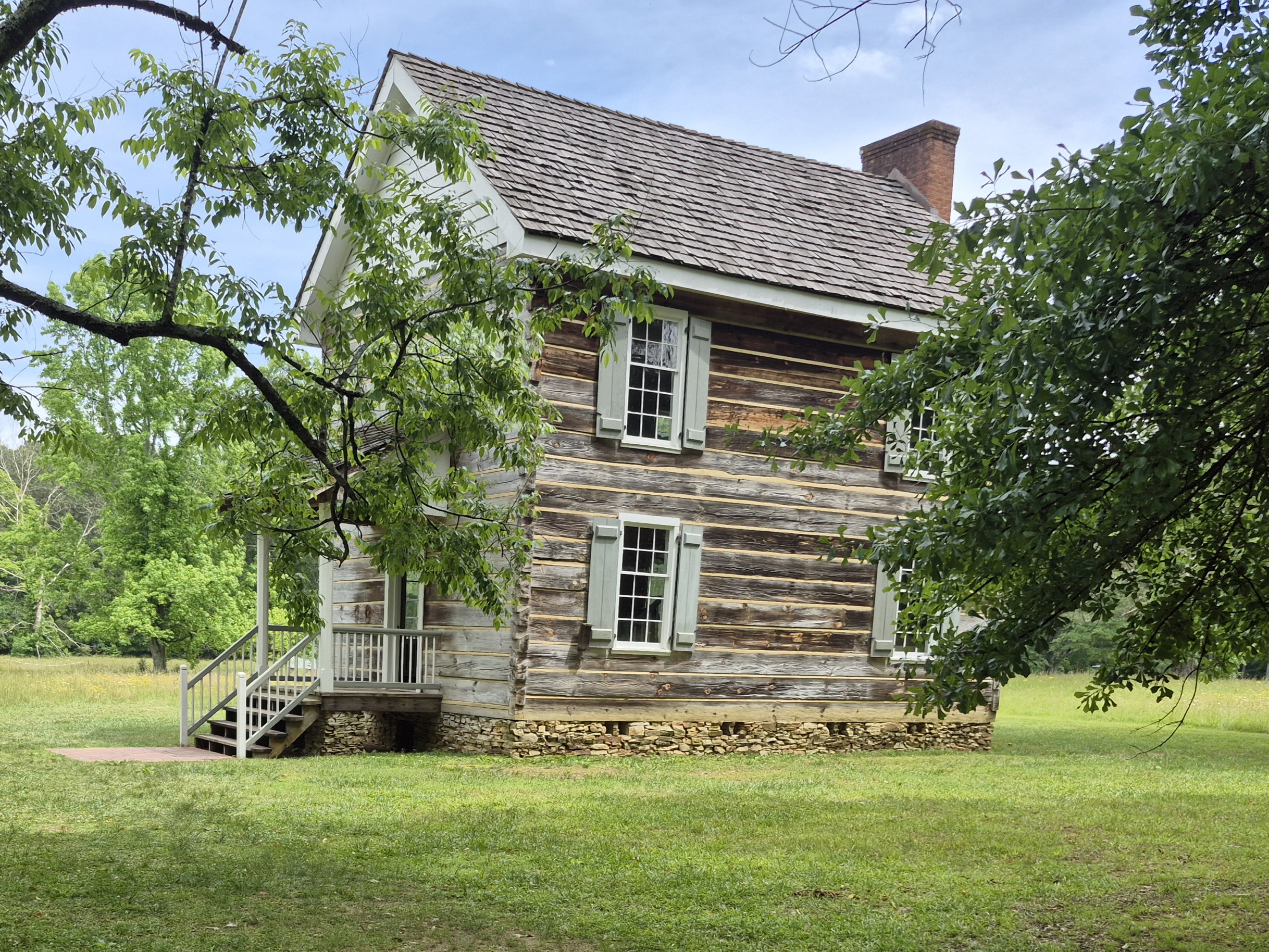
The buildings are a combination of original (mainly the Worcester House) and reconstructed buildings, with Vann Tavern having been brought in from another site nearby.
I kept thinking of how many people made this their home, long before they knew what was coming.

When you arrive, buy your ticket at the park ranger desk inside. They will give you a brochure to follow a self-guided tour, unless you arrange a guided or group tour in advance.
You can view various buildings like the dwelling house, smokehouse, barns, corn cribs, and others that were common in the 1800s. Some of them are original buildings that were found elsewhere and brought here, and some of them are recreations. There were more than 4,000 buildings and homes similar to these and the Georgia section of the Cherokee Nation when the Trail of Tears started.
I do not want to spoil everything, but here are some of the coolest features.

THE CHEROKEE PHOENIX
In 1828, the Cherokee Nation began publishing The Cherokee Phoenix in New Echota, making it the first Native American newspaper in the United States. It was published in both English and Cherokee, using Sequoyah’s syllabary that was developed in 1821. Something I found particularly cool was that it was printed on a Washington-style press that uses specially cast type for the Cherokee syllabary alongside English type.
The Cherokee Phoenix focus was to share news, laws, and political commentary while communicating and asserting the Cherokee Nation’s rights and sovereignty to both Cherokee readers and outsiders. Both the name and the phoenix symbol represented renewal, progress, and strength of the Cherokee people.
In 1829 there was a name change to The Cherokee Phoenix and Indians’ Advocate, which reflected a focus on broader Native American affairs. Elias Boudinot, an educated Cherokee leader, was the editor.


THE WORCESTER HOUSE
Reverend Samuel Austin Worcester was a missionary and outspoken advocate for Cherokee rights. He built this house, the only original building still standing on the historic site, in 1828 as his family residence and as the New Echota Mission Station.

Worcester, along with his wife, Ann, and daughter, Ann Eliza, moved to New Echota in 1827. He established a church and school, served as the town postmaster, and helped translate portions of the Bible and hymns into the Cherokee language.


THE COUNCIL HOUSE
New Echota was not simply a village, it was the capital of a Nation. It contained a legislative system with courts and written laws, and the two-story Council House served as the Cherokee Nation’s main legislative building.
It could hold 32 members of the National council on one floor and an additional 12 members of the National Committee on the other. Bills had to pass in both houses to become a law.

VANN TAVERN was a Cherokee home and store, open to visitors and travelers alike.


It was originally located in Forsyth County and relocated to New Echota in 1955.

BOUDINOT HOUSE
The home that once stood here belonged to Elias Boudinot, editor of The Cherokee Phoenix, and it was built in 1827. Four stone markers indicate each corner of the former house, allowing one to imagine the space it occupied.
One interesting detail I read about Boudinot was that he is considered to be a betrayer of the Cherokee. For someone who was once so highly regarded for his work advocating for and asserting Cherokee sovereignty, and who opposed the forced removal, his act of caving into pressure and signing the Treaty of New Echota was seen as the most elevated act of treason.
Perhaps he went too far in his role of speaking for the Cherokee. Perhaps that is why his home was never rebuilt, when many other significant buildings in New Echota were.

Beyond historic homes and sites, be sure to wander some of New Echotas walking trails.
POND OVERLOOK TRAIL is a 0.3-mile loop trail that follows the original 1800s road from the river ferry.

NEW TOWN CREEK NATURE TRAIL is a one-mile loop through pine and hardwood trees, past the beaver pond, to an overlook of the New Town Creek.


KIND OF A BIG DEAL
The biggest takeaways are that, first, New Echota was the political capital and center for the Cherokee, and its disassembly by the white folk was on BIG purpose. Removal of the Cherokee was an assault on their sovereignty at the time, but not the end of their culture or history.
Second, New Echota was not just another stop on the Trail of Tears. It is a profoundly significant historic site because it was the Cherokee capital AND where the controversial treaty was signed that set forced removal into motion.
Third, New Echota may have been lost, but its archaeological remains were investigated and parts of it have been reconstructed to see what that EXACT place was like, not just any former Indigenous site.
The New Echota State Historic Site is currently open Tuesday-Saturday 9 am-5 pm and Sundays 1-5 pm (closed Mondays) and admission is $6-$8. Check the website for any changes before you visit.
I would plan for 2-3 hours to visit the museum, tour and read about each of the historic structures, and walk the trails. Leashed pets are welcome on the trails but not inside any buildings.
Here are a few more additional resources about New Echota, the Treaty of New Echota, and the Trail of Tears.
The Indian Removal Act and Treaty of New Echota: Historical Thinking with Primary Sources
The Treaty of New Echota: How the US Government Stole Georgia
Will Congress Fulfill a 184-Year Old Promise to the Cherokee?
The Treaty of New Echota & the Jarring Reality of Cherokee Removal
New Echota: Capital of the Cherokee Nation
The Cherokee Nation: The Story of New Echota

In the area for a while? Follow me to some other rad places in north Georgia like Dalton, Calhoun, Rome, Cartersville, Blue Ridge, McCaysville, Rabun County, Dahlonega, Ellijay, Blairsville, Helen, and Anna Ruby Falls.
*************
© Fernwehtun, 2015- Current. Unauthorized use and/or duplication of this material without express and written permission from this site’s author and/or owner is strictly prohibited. Excerpts and links may be used, provided that full and clear credit is given to Fernwehtun and Fernwehtun.com with appropriate and specific direction to the original content.

Leave a Reply